Women of Mekar Raya, Guardians of Local Knowledge
- The indigenous Dayak Simpankng women in Ketapang, West Kalimantan, are forest guardians and caretakers of local knowledge. They rely on rubber plantations (rubber forests) and shifting cultivation. They also hunt, fish traditionally, and gather non-timber forest products from tembawang, bawas, protected forests, and surrounding forests.
- Serina Greta, an indigenous Dayak Simpankng woman, knows many plants in this customary forest. She gained this knowledge from her mother, who received it from her grandmother. This is passed down through generations due to the oral culture of the Dayak community.
- Women are the group most closely connected to the forest. Rituals are also documented from women's narratives, including customary sanctions. They teach and pass on forest or village activities to the younger generation.
- The process of determining areas and forest management is often unbalanced and even reinforces gender inequality. In Mekar Raya Village, the determination of areas and biodiversity documentation in the village forest involves women. The village women are very active. They are deeply connected to the forest. Mekar Raya women do not only hold domestic roles.
Serina Greta led a group into the customary forest last November. Joining the group were several village youths and traditional leaders. This 40-year-old woman showcased the richness of their customary forest in Mekar Raya Village, Simpang Dua District, Ketapang, West Kalimantan.
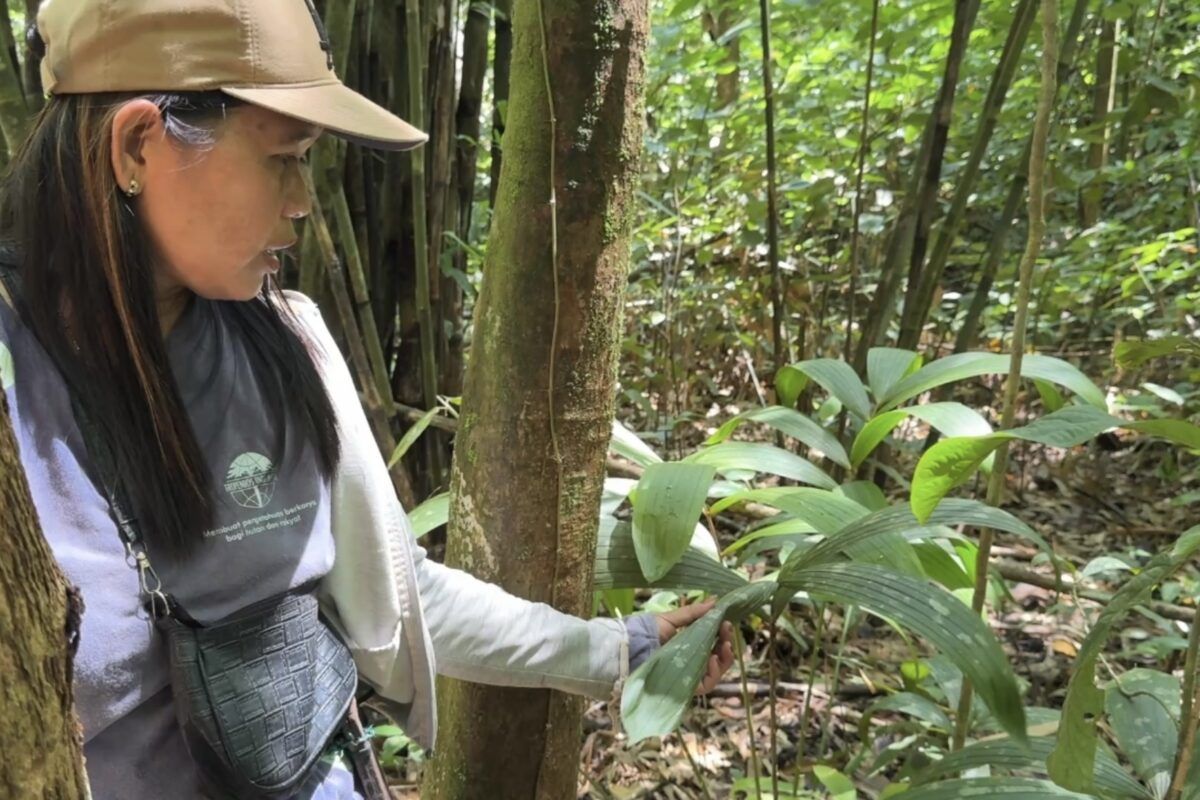
She walked at the front, occasionally stopping at some trees or plants to explain their local names and uses.
"This is doga, one of the stir-fried vegetables that can be mixed with bamboo shoots," said Serina, showing a long-leaved plant with a pointed tip, resembling a plant from the ginger family.
A few steps later, she showed a plant locally named maliali or mali-mali. Among the Dayak Simpankng community, maliali is used to treat burns or blisters. The method is simply to apply the leaf to the affected body part.
Dayak Simpankng also use maliali for certain traditional rituals. There is a ritual called mulang semparan, which is a ritual for opening fields, nyapa tahun, for thanksgiving after the harvest season, and bebantan, a ritual for cleansing the village.
"The bebantan ritual cleanses the village from bad things, so the village is not affected. Usually, it is done every three years," said Serina.
Serina showed a cluster of bemban. Bemban or bamban is a type of herbaceous plant. It grows in clusters with soft stems, and when mature, it does not exceed two meters in height. It is usually an annual or perennial plant.
"We can take the water from the young buds of this plant, which serves to clear vision," she said.
Serina also showed a type of mushroom. It is called kulat tempurung, used to treat bedwetting in children.
She demonstrated the preparation of traditional medicines. A traditional concoction commonly consumed by Mekar Raya women is a drink to promote health and relieve fatigue. Serina makes this drink regularly once a week.
This concoction can also be used for postpartum recovery.
"The ingredients include ginger, kencur, lemongrass, and turmeric. It is used for postpartum healing and is consumed every day for a week."
The medicine does not have a name, but all the women in Mekar Raya Village know the benefits of this drink.
Serina knows many plants in this customary forest. She gained this knowledge from her mother, who received it from her grandmother. This is passed down through generations due to the oral culture of the Dayak community.
She said they are trying to document medicinal plants and food crops in their forest to create a book.
"Hopefully, if the book listing medicinal and spice plants is completed, it can be read by future generations or become knowledge for the wider community," hoped Serina.
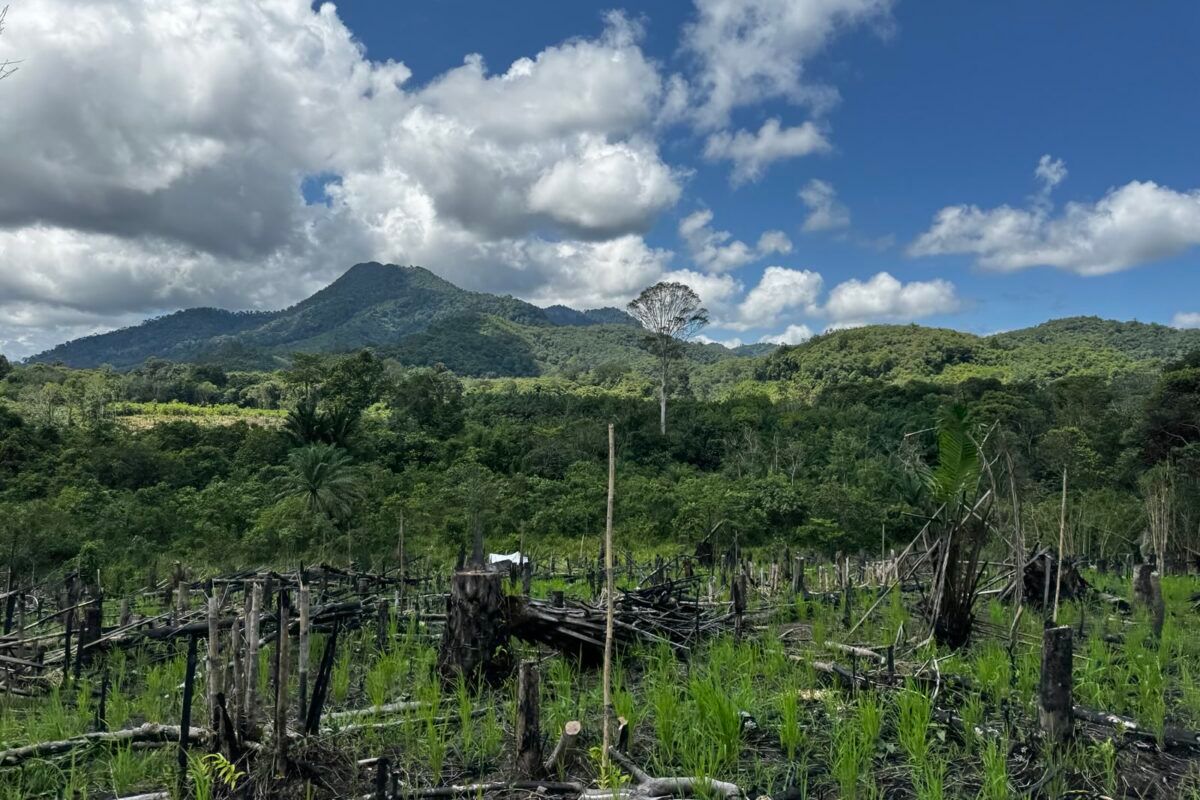
Mekar Raya Village was previously divided into five hamlets, namely Baya Keranji Hamlet, now Batu Daya Village, Kembra Hamlet became Kamora Village, and Merangin Hamlet became Kampar Sebomban Village.
The settlement pattern of the community is linear, following the river pattern. The settlement of Simpang Dua Village meanders along the river and hills.
The indigenous community relies on rubber plantations (rubber forests) and shifting cultivation. They also hunt, fish traditionally, and gather non-timber forest products from tembawang, bawas, protected forests, and surrounding forests.
This village is eight kilometers from the provincial road. They have several managed forests included in the community-managed conservation area (AKKM).
The Dayak Simpakng indigenous community plans land use and space allocation, including tembawang, mostly located in the conversion production forest area (HPK), protected forests, and a small portion of other use areas (APL).
Tembawang in these three areas is designated for economic purposes with fruit yields. There is also a sacred forest located in the HPK status land.
"This forest is for traditional purposes and a place for medicinal plants to grow. Some areas are completely off-limits except for ritual purposes," said Serina.
For clean water sources, the community relies on Bukit Berugak and Senibung.
There is also Bukit Semugo, located in the protected forest, as a place of worship and the resting place of ancestors. Including the Sacred River as a breeding ground for fish, a forbidden fishing area, and a site for traditional rituals. Serina also mentioned Mount Timur as a religious tourism site and waterfall.
Women, she said, help protect this forest so it can be sustainably used by the indigenous community.
The process of determining areas and forest management is often unbalanced and even reinforces gender inequality. In Mekar Raya Village, the determination of areas and biodiversity documentation in the village forest involves women.
"We help monitor area mapping and check the locations," said Serina.
The village women are very active. They are deeply connected to the forest. Mekar Raya women do not only hold domestic roles.
Intersectionality is very evident. Serina is fluent in explaining the forest boundaries. The area we entered is the tembawang area. In this area, there are many fruit trees. The Tembawang forest usually has humak or resting houses, not far from the agricultural area.
The Dayak community practices shifting cultivation, often building houses or huts for resting. The hut area becomes tembawang. The forest fruits they eat are then planted.
After harvesting, the area is left. Sometimes when they return here to farm, the seeds they planted have grown large.
"While harvesting (fruit picking) when we were young, our parents told us the meaning of the plants in this forest, the names of fruit trees, or how to care for the forest," she said.
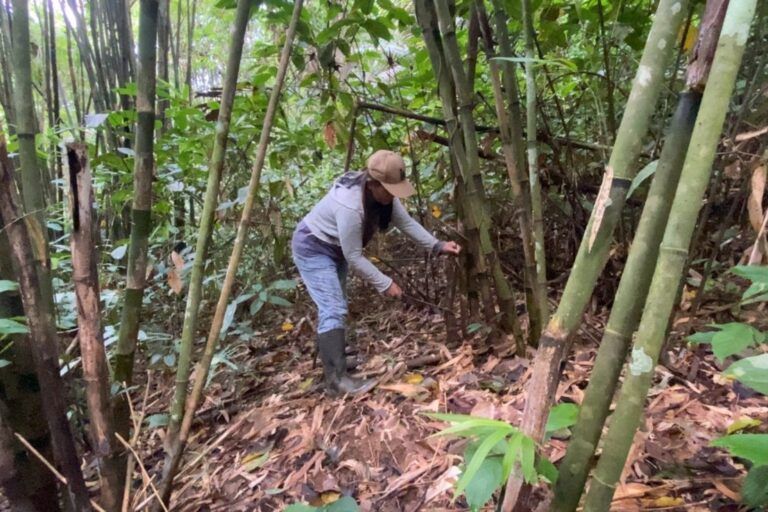
This story is retold to their children. Mekar Raya women will tell stories while dining or exchanging stories before bed. Meanwhile, the process of knowledge enrichment among women usually occurs while they weave, braid, or cook together.
As times change, residents want to document biodiversity through books. "We want to record every medicinal plant and spice plant in this forest," she said.
Women are the group most closely connected to the forest. Rituals are also documented from women's narratives, including customary sanctions. They teach and pass on forest or village activities to the younger generation.
Sacred areas are completely off-limits to residents, except for traditional ritual purposes. There, also live animals like clouded leopards. The clouded leopard is a rare and protected wild cat species.
The customary sanctions they impose vary. "It depends on the severity of the violation," said Serina.
Tondi, representing his father; 'Pak Adat' of Mekar Raya Village—who only speaks Dayak—explained the position of women in customs.
Women, he said, play an important role as caretakers of knowledge. In several traditional ceremony sessions, they contribute to preparing the processions. From the procedures to verbally explaining to the younger generation the meanings of the processions, including the materials to complete them.
"For example, in the talam panuta ceremony during a wedding, women are directly involved," he said.
Women also explain to children not to play carelessly in the river.
For the indigenous community, the river is the lifeblood. Therefore, it is taboo for Dayak residents to damage the river. In the sacred fishing area rules, the location must not be disturbed, including the prohibition of fishing.
"Sometimes what people fear is not the customary sanctions, but the sanctions from the guardian there."
The rules regarding the prohibition of entering the sacred forest are also narrated by women. Anyone entering the sacred forest will receive sanctions. Not only customary sanctions, but often they also come from 'The Guardian.' This is evident if the violator falls ill with a strange illness.
Reject palm oil
This village once faced the prospect of a palm oil company entering. The community, including the women, firmly rejected the threat to their customary territory. Serina, one of the vocal Mekar Raya women, opposed the palm oil company.
"Initially, they came and directly asked about the HGU area and stated that our area was clear so they could work on it," said Serina.
Residents immediately showed maps indicating that their forest had become a village forest, protected forest, customary forest, and was in the process of legalization at the center, so the company could not enter at will.
The company borders the village. Residents even found several violations, such as the issuance of an IUP on April 1, 2005, before the location permit was issued on April 27, 2005.
The IUP was allegedly issued without an environmental impact analysis (Amdal). The Amdal was only available in 2011. The right to cultivate (HGU) covering 12,500 hectares was issued in 2013, while land compensation to the community for 9,800 hectares was only completed in 2019.
In 2023, landowners also reported the company for planting outside the HGU. It was proven from boundary measurements showing the company's activities outside the HGU. On April 11, 2023, mediation did not take place because the company did not attend.
Residents firmly reject it because the forest is a source of life for the community. Not to mention, seeing the surrounding villages damaged after the palm oil company entered.
"We do not want there to be no bird sounds later, animals also difficult to find. Things that have been preserved since our ancestors, of course, we try to protect as much as possible."
Cambang Cornelia, a Mekar Jaya weaver, said the forest is the heart of their village. "That is where water from the mountains flows to the village and for daily needs. If it is turned into palm oil or a company enters, it will clearly deplete the forest and water, which will eventually deplete humans too," said the 57-year-old woman.
Gusti Suganda, from Tropenbos Indonesia—a community assistance organization—said the right to manage the village forest was given to the Village Forest Management Institution based on the Decree of the Minister of Environment and Forestry of the Republic of Indonesia Number: SK 5744 in 2022. The village forest area is 1,107 hectares, and "Yulius Yogi is the head of the LPHD.
He looked back. In 2014, the palm oil company tried to approach the community by marking boundaries in Mekar Raya Village and was immediately met with strong rejection from the community.
Tropenbos proposed protecting around 200 hectares of tembawang areas (35 locations) and 13 spring areas. This also includes seven traditional sacred locations, which are the natural habitat of the clouded leopard, considered the ancestors of the Dayak Tribe. The habitat they believe is the living place of the clouded leopard becomes a closed area, even for agriculture.
Forest, source of life
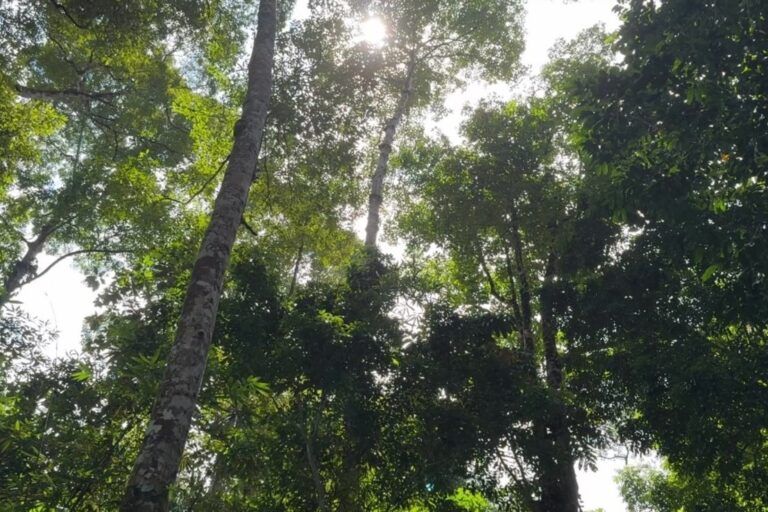
Yulius Yogi, a youth leader in Mekar Raya Village, said they strictly guard their forest. "The forest is divided into three layers, namely bawas or fields, tembawang, and wilderness," he said.
Tembawang is a part of the forest rich in natural resources such as fruits, medicinal plants, and weaving materials. Meanwhile, the wilderness is the deepest part of the forest, rarely entered by the community.
For the Mekar Raya community, tembawang is the most beneficial forest layer for them as it is a place to find fruits like durian, cempedak, gandaria, tengkawang, cemrangan, and various medicinal plants.
Tembawang Mekar Raya is also the largest producer of durian in Ketapang. One tembawang point can produce 2,000–3,000 durians during the season and becomes an additional source of income for the Mekar Raya community. Initially, tembawang was the former field of ancestors.
Tembawang is the heart of the livelihood of the Mekar Raya community, especially women. It is the source of food and daily raw materials.
The women gather weaving materials to make handicrafts or mats. They also pick fruits during the harvest season, such as durian, cempedak, kandaria, langsat, duku, mentawa, and pekawai. Additionally, they obtain water from springs within the area.
Fransiska, a bembang weaver, said she has been weaving since childhood. She now passes on this skill to the younger generation to preserve the weaving tradition and provide additional income.
"We already have a weaving group."
The knowledge of weaving, including material selection, motifs, and colors, is passed down through generations. They usually make bags, baskets, wallets, and book covers. Prices range from Rp5,000 to Rp300,000. "We usually find materials in the forest because everything is there," said Siska.
Besides weaving, she also farms, taps rubber, and waits for durians to fall.
The activity of waiting for durians to fall has become a tourist attraction in Mekar Raya Village. Every durian season, many people flock to join the locals in waiting for durians to fall.
However, the Mekar Raya community prohibits those who join in waiting for durians from selling them, only for personal consumption. Waiting for durians usually takes place from 7:00-9:00 PM by men, women, and children.
"When waiting for durians, parents will bring their children to learn directly. Children are also eager to join in waiting for durians," said Cambang.
The river flow sourced from the sacred mountain springs is a source of village income. They use the water source to make refillable gallon water. This model also strengthens efforts to protect the forest. If conversion occurs, the water source will be threatened.
"The neighboring village's water is not as good as ours because a company has already entered there. Whether it's due to pollution or waste from the company that depletes the springs and makes their water murky," said Serina.
They do not want damage to occur in their forest. That is why the residents of Mekar Raya, including the women, are determined to protect the forest.
Not only do they show their role in forest and customary territory protection, but Mekar Raya women also preserve local knowledge. They protect the forest while utilizing it wisely.

Join Our Newsletter
Berlangganan buletin kami untuk mendapatkan pembaruan terbaru, berita, acara, dan aktivitas komunitas langsung ke kotak masuk Anda.
We respect you privacy, your email is safe with us.