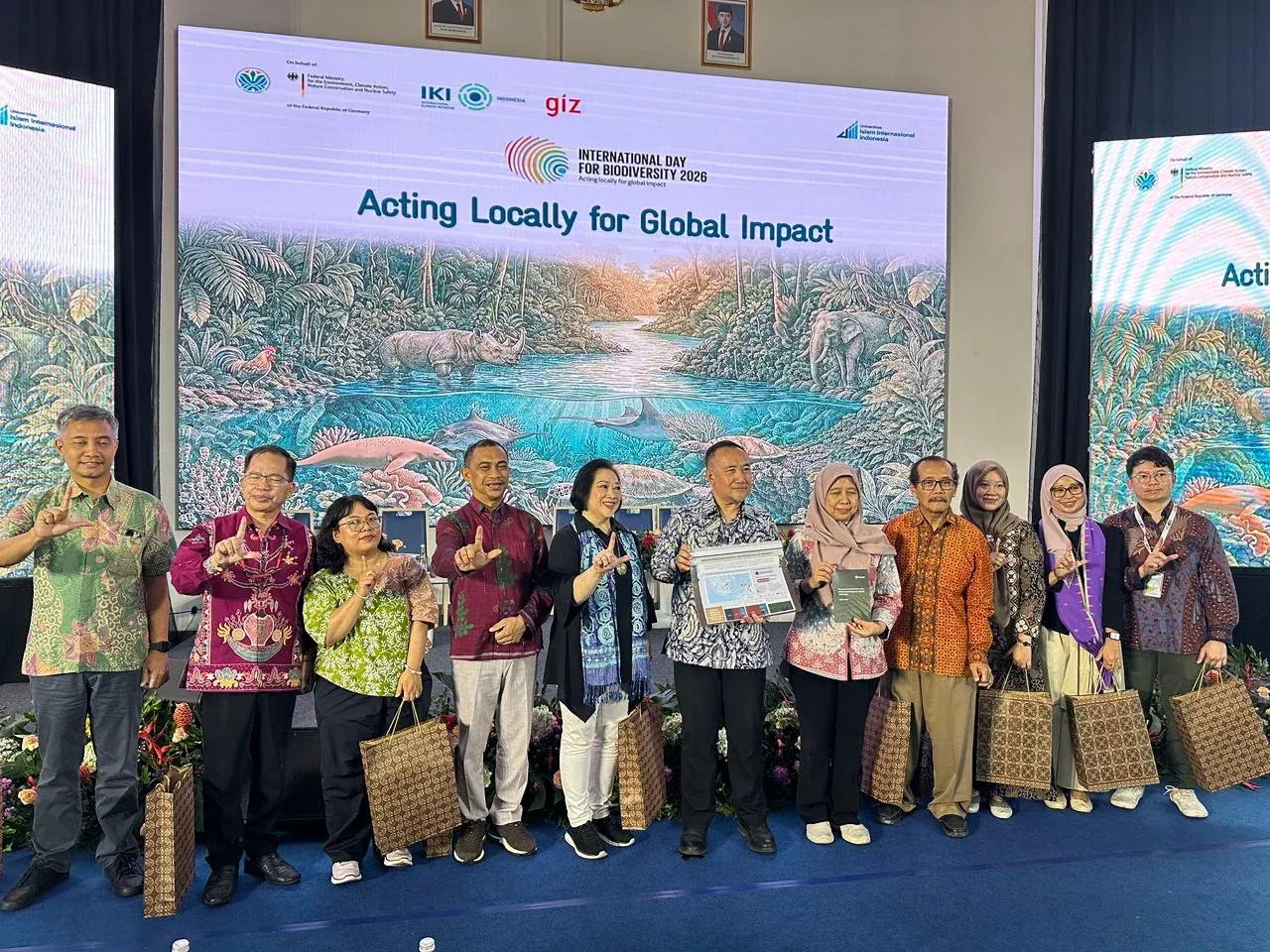
Commemorating the 2026 International Day for Biological Diversity: WGII Unveils 1 million hectares of ICCAs as Indonesia’s Biocultural Heritage
(Depok, May 22, 2026) Since the year 2000, May 22nd has been globally recognized as the International Day for Biological Diversity. Marking this momentum, the Working Group ICCAs Indonesia (WGII) took the stage as a panel speaker at an event hosted by the Directorate of Biodiversity Conservation, Ministry of Environment.
This year’s celebration carries the theme, “Indonesia’s Progress and Achievements in Biodiversity Conservation #RoadtoCBDCOP17.” As a key non-governmental actor in attendance, WGII launched critical data on ICCAs (Indigenous Peoples and Local Community Conserved Territories and Areas). This initiative highlights the values, practices, and generational traditions of environmental stewardship and habitat protection by Indigenous Peoples and Local Communities (IPLCs).
The living spaces of IPLCs, often narrowly defined merely as “natural resources”, are living proof that when a community’s habitat vanishes, we lose more than just an ecosystem. We lose the profound connection between humanity and nature, ancestral traditions, and the future of generations to come.
Over 1 million hectares of Community Conserved Areas Successfully Documented
As of May 2026, WGII, in collaboration with IP&LCs and supporting organizations, has successfully documented 1,010,430.68 hectares of ICCAs. These are territories safeguarded, protected, and managed by local communities using indigenous wisdom and traditional knowledge. Nationally, the potential footprint of these ICCAs is estimated at a staggering 29,545,402.06 hectares.
The largest expanses of these documented community conservation areas are distributed across the archipelago as follows:
- Kalimantan: 671,323.60 hectares
- Sulawesi: 127,051.43 hectares
- Sumatra: 89,543.39 hectares
- Papua: 52,389.85 hectares
- Maluku: 50,186.79 hectares
- Java, Bali, and Nusa Tenggara: 19,935.50 hectares
These numbers are more than just land metrics; they reflect a rich cultural diversity intricately woven into successful management efforts and the conservation of biodiversity at both the species and landscape levels.
WGII’s analysis of the National ICCA Registration data reveals that 69.3% of these community living spaces encompass critical, high-value ecosystems. This includes mangroves, natural forests, karst landscapes, peatlands, coral reefs, and seagrass meadows. These diverse ecosystems are deeply interconnected, with IPLCs playing an indispensable role in maintaining their ecological functions and overall sustainability through local governance.
“Indonesia is not just a megadiverse country; it is a biocultural powerhouse. This biocultural aspect is vital across three dimensions: nature and biodiversity, knowledge, and language.” - Cindy Julianty, Executive Coordinator, WGII
This ecosystem diversity goes hand-in-hand with species diversity and sustainable utilization. “We are also uncovering the use of biodiversity in the context of bioprospecting. These resources serve a multitude of purposes, supporting local economies, livelihoods, food security, cosmetics, and sacred rituals,” Cindy added.
She further explained that the field data has undergone rigorous verification with the communities themselves. “We found numerous case studies proving that traditional knowledge isn’t strictly compartmentalized by ecosystem type. Even within a single conservation site, the ecosystems can be incredibly varied, some small, some expansive. No matter how big or small, every ecosystem and ICCA is equally important.”
Local Languages and Traditional Knowledge in Indigenous Conservation Practices
WGII is championing the decolonization of how we view biodiversity conservation, shifting the paradigm toward a community-centered perspective. This step is crucial, especially as current threats extend beyond physical biodiversity loss to the alarming erosion of Indonesia’s local languages.
Language is the cornerstone of biocultural wealth. Therefore, in documenting ICCAs, prioritizing local terminology and vernacular names for biodiversity is essential.
“This demonstrates that traditional knowledge is inextricably linked to the sustainability of biodiversity,” stated Cindy. She asserted that conversations surrounding biodiversity can no longer rely on siloed, single-discipline approaches. Ecological sustainability cannot be divorced from social sustainability. “Biodiversity is inherently multidisciplinary. We must ensure not just the sustainability of nature, but the sustainability of society. There is no nature sustainability without social sustainability.”
Ultimately, WGII sends a firm message to the Ministry of Environment: biodiversity conservation is inseparable from recognizing the socio-ecological relationship between Indigenous Peoples, Local Communities, and their territories.
Consequently, the implementation of the Indonesian Biodiversity Strategy and Action Plan (IBSAP) must guarantee that IPLCs are positioned as rights-holders and central subjects in conservation efforts. This includes safeguarding their traditional knowledge and officially recognizing the territories they have sustainably protected for generations.
---
For additional information, the latest documentation and data on ICCAs can be downloaded at the following link.
Contact
Lasti Fardilla Noor
Knowledge Management Manager, WGII
+6281388601039
[email protected]
Mega Ayu Lestari
Communications and Engagement Officer, WGII
+6287771425519
[email protected]

Join Our Newsletter
Berlangganan buletin kami untuk mendapatkan pembaruan terbaru, berita, acara, dan aktivitas komunitas langsung ke kotak masuk Anda.
We respect you privacy, your email is safe with us.