Peoples’ Conservation Summit: Weaving Narratives from the Cultural Diversity of Conservation
(Jakarta, June 29, 2026) As a living practice embedded within communities, conservation takes on many forms, methods, terms, and deeply rooted values to sustain living spaces across generations. Today, however, these spaces face a harsh reality: the governance and management of forests and high-conservation-value areas are becoming heavily entangled with extractive architecture. This creates a political, economic, and institutional nexus where natural resources are massively extracted by multiple actors across a region, while the profits flow exclusively to a select few.
This governance model is reaching its nadir. A glaring example is the Ministry of Forestry Decree No. 591 of 2025 concerning the Change of Forest Area Designation, which clears the way for an extractive project in South Papua Province spanning 587,750 hectares, an area larger than the Island of Bali. This starkly undermines the values and efforts of community-based conservation, which have historically been the backbone of achieving global biodiversity targets. Undoubtedly, both now and in the future, it is crucial for the state to prove that the power of the law will once again stand with the vulnerable.
Decolonizing Conservation: the Kick-Off
Amidst the dynamics and incoherence of environmental policies, recognizing the rights of Indigenous Peoples and Local Communities (IPLCs) over their living spaces is an absolute prerequisite for managing biological resources. To mainstream this cultural diversity in conservation, the Working Group ICCAs Indonesia (WGII) officially launched the Kick-off for the Peoples’ Conservation Summit (PCS), a preliminary event leading up to the main summit in early September 2026.
This kick-off aims to introduce the decolonization of conservation into biodiversity protection and management policies. It also serves to share the core concepts of the PCS and strengthen collaboration, commitment, and strategic support among a wide array of rightsholders and stakeholders, ranging from the government, IPLCs, and academia to Civil Society Organizations (CSOs), and development partners in Indonesia.
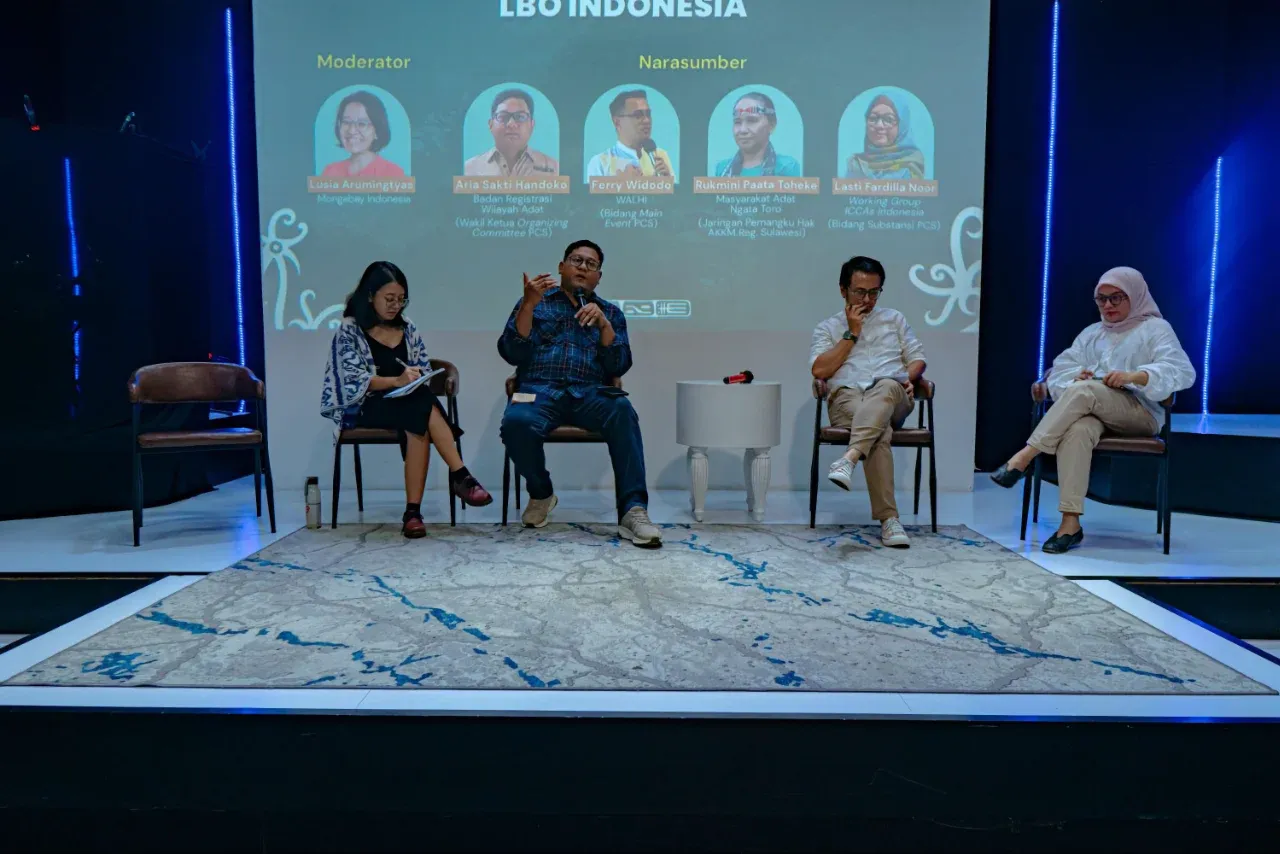
The event, carrying the hashtag #RoadtoCOP17CBD, was hosted in a hybrid format from the PIC Creative Space in Jakarta, gathering over 59 virtual participants and 27 in-person attendees. It marks the first step toward the September 2026 summit and the preparation of international negotiation materials for the COP17 UN CBD in October 2026.
The Core Problem: Exclusionary Paradigms
During the opening session, Cindy Julianty, Executive Coordinator of WGII, emphasized that the biodiversity crisis is inextricably linked to development and conservation paradigms that consistently fail to place communities as central subjects.
“Why does biodiversity loss continue despite ongoing conservation efforts? The primary cause is development that leans heavily on extraction. Second, the conservation perspective remains fractured between scientific-based and rights-based approaches; if we look at our conservation laws, current policies do not yet side with community rights. Third, genuine spaces for dialogue on human rights-based conservation have not been truly established. Therefore, we need cross-sectoral dialogue within a single platform where Indigenous Peoples take the lead as the primary actors, namely, through the Peoples’ Conservation Summit,” said Cindy.
This perspective highlights that Indonesia’s conservation challenges are not merely about protecting ecosystems; they are fundamentally about governance, rights recognition, and spaces for public participation. This reality becomes painfully apparent on the ground, particularly regarding the overlap between the Indigenous Peoples’ territories and natural resource exploitation permits.
Overlapping Territories and Spatial Inequality
Aria Sakti Handoko from the Indigenous Territories Registration Agency (BRWA) reinforced this by presenting startling data on the mounting pressure on Indigenous living spaces. “Currently, according to BRWA data, there are approximately 7 million hectares of mining concessions and other business permits directly overlapping with the Indigenous Peoples’ territories. The PCS agenda this September serves as the momentum to consolidate community narratives at the grassroots level.”
This data reveals that conservation issues cannot be divorced from tenurial conflicts and spatial inequality. Consequently, the PCS is designed not just as a discussion forum, but as a crucible for consolidating grassroots experiences to build a tangible agenda for policy change.
Echoing this sentiment, Ferry Widodo from WALHI (Friends of the Earth Indonesia) explained that the PCS is a platform for IPLCs to convey their lived experiences and political mandates directly to the international community.
“The PCS is the people’s forum, a place where Indigenous Peoples speak directly. The hope for this summit is to formulate a factual document born directly from the grassroots. It is these direct voices and mandates from the people that we will accommodate and amplify at COP17 CBD in Armenia, to show the world that the state of communities and the environment in Indonesia is not doing well.”
Traditional Knowledge as Modern Science
Beyond drafting policy recommendations, the PCS represents a milestone for injecting Indigenous perspectives into global conservation forums. The lived experiences of these communities are living proof that community-based conservation has thrived for centuries, long before the modern concept of “conservation” was ever coined.
Rukmini Paata Toheke, Coordinator of the Custodian Network for ICCAs (Jaringan Pemangku Hak Areal Konservasi Kelola Masyarakat) for the Sulawesi Region, noted that Indigenous conservation is deeply rooted in ancestral, intergenerational knowledge. “We don’t just guard the forest; we carry out our ancestral legacy to understand which spaces can be managed, which must be left untouched, and how to manage them wisely for our collective survival.”
The Numbers Speak for Themselves
These practices are more than just cultural heritage; they are highly effective, quantifiable contributions to the protection of Indonesia’s biodiversity. National ICCA data as of May 2026 records 527 ICCAs covering 1,010,430.68 hectares, successfully managed by 169 Indigenous Peoples and 23 Local Communities. Spatial mapping indicates a potential expansion of ICCAs to a staggering 29.5 million hectares across Indonesia.
These findings decisively prove that IPLCs are the ultimate frontline actors in maintaining ecosystem sustainability. Their success stands as a powerful antithesis to the exclusive, centralized, colonial-legacy approach of “fortress conservation”, a model that frequently triggers tenurial conflicts and the criminalization of local communities within state-designated conservation areas.
Through the Peoples’ Conservation Summit, WGII invites the government, academia, CSOs, development partners, and all stakeholders to jointly drive a fundamental transformation in Indonesia’s conservation paradigm. The goal is clear: a shift toward an approach that unequivocally recognizes the rights of Indigenous Peoples and Local Communities, champions social justice, and guarantees the vibrant sustainability of biodiversity for generations to come.
For further information, please visit:
COMING SOON | Peoples’ Conservation Summit 2026 | GIK Jogja, 1–3 September 2026
and our website here https://pcs.iccas.or.id/.

Join Our Newsletter
Berlangganan buletin kami untuk mendapatkan pembaruan terbaru, berita, acara, dan aktivitas komunitas langsung ke kotak masuk Anda.
We respect you privacy, your email is safe with us.