Sasi Lompa, Tradition of Coastal Protection by Haruku People
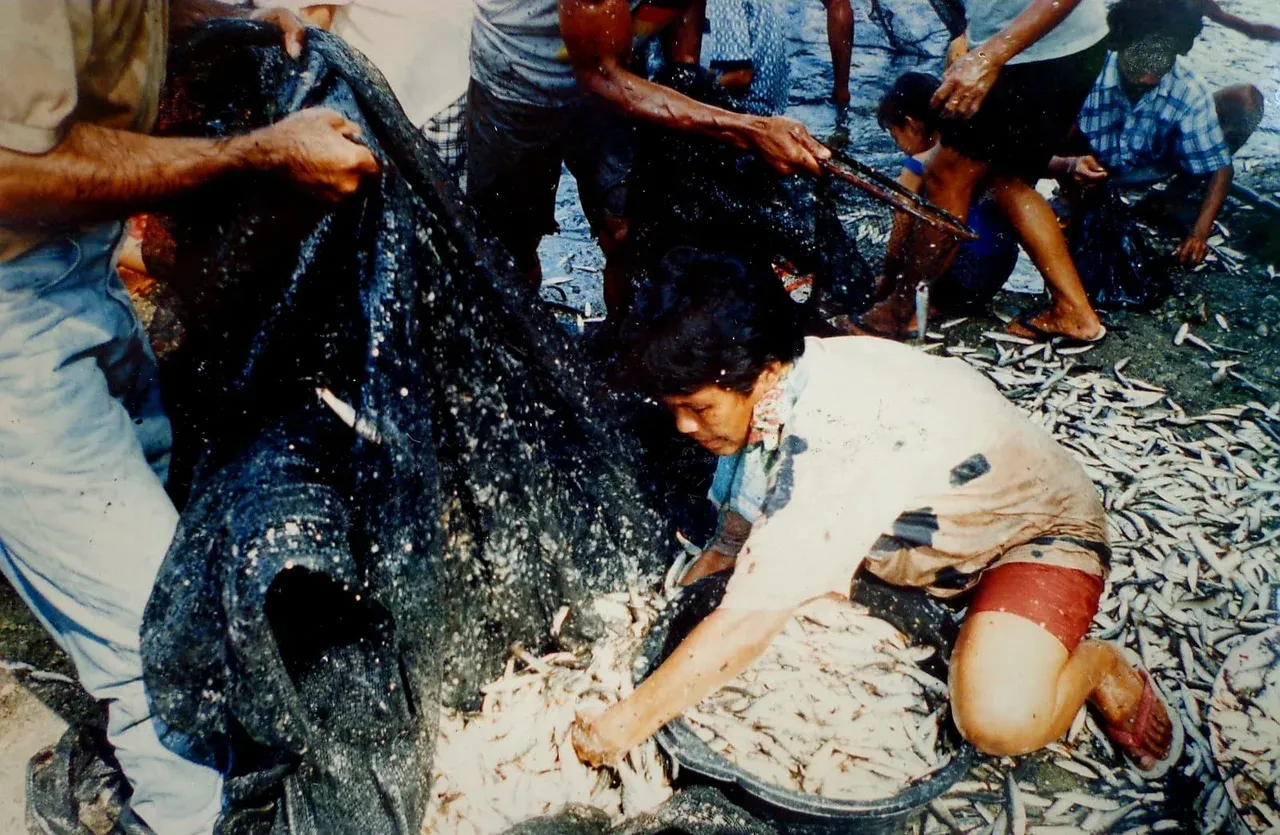
- As a way to preserve the sea, the Haruku people in Maluku have a tradition called sasi lompa. This tradition has been passed down for generations and remains preserved to this day.Lompa is a type of fish that is abundant in Haruku waters. This tradition is carried out by the kewang led by the Chief Kewang.
- The Haruku community loves nature and is also its guardian. In 1985, the Haruku community even received the Kalpataru award for their protection practices from land to sea through the sasi system.
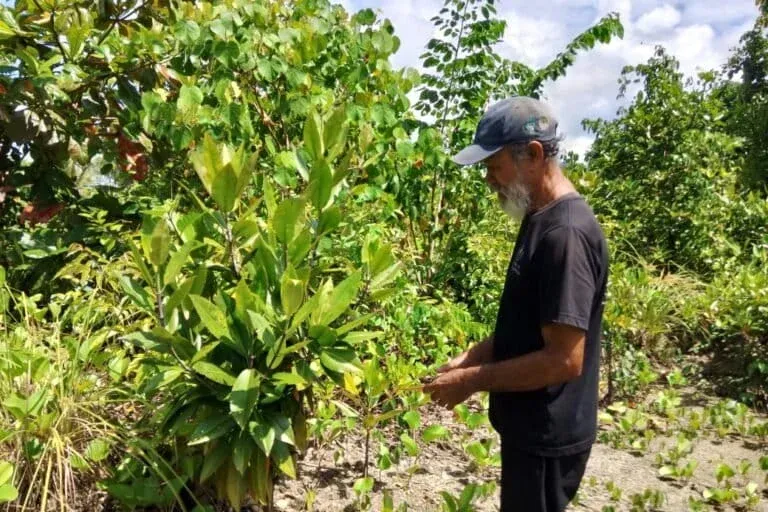
- Eliza Kissya, the Chief Kewang of Negeri Haruku, is 75 years old. Although in his seventies, he is full of spirit to continue nurturing the traditional values of the Haruku people. He is persistently protecting the Haruku environment. Opa Eli also received the Kalpataru award in the environmental mentor category in 2022.
- Jean Carlla Warella, a graduate of Pattimura University, Faculty of Teacher Training and Education, in her research explains that there are several factors influencing the presence and density of lompa, such as biotic factors like plankton (phytoplankton and zooplankton) and abiotic factors like temperature, salinity, current speed, and water clarity.
"Everyone has acknowledged the great benefits of agarwood, its original name is Negeri Haru Ukui, meaning the tip of the waru tree. We are all Melanesian people, our culture is almost the same. My grandchildren Emil and Patricia, left their mother since they were little."
Thus began the poem of Eliza Kissya, also known as Opa Eli, the Chief Kewang, when we visited the Kewang house in Negeri Pelasona last October. The sea breeze blew gently. The sound of waves crashing against the shore was heard.
Haru'Ukui, the local language for Negeri Haruku. It is a traditional village on the coast of Haruku Island. A peaceful village with beautiful seas between three tanjong (capes), namely, Tanjung Negeri Tengah-tengah, Salahutu District; Tanjung Hutumuri, South Leitimur District, and Tanjung Seri, Nusaniwe District.
Haruku faces Ambon Island, within the administration of Haruku Island District, Central Maluku, Maluku.
Eliza Kissya, the Chief Kewang of Negeri Haruku, is 75 years old. Although in his seventies, he is full of spirit to continue nurturing the traditional values of the Haruku people. He is also persistently protecting the Haruku environment. Opa Eli also received the Kalpataru award in the environmental mentor category in 2022.
Kewang is a special position in the traditional governance system. Kewang is present to protect the environment both on land, at sea, and within the village. Kewang in Negeri Haruku functions as a traditional judge who will impose sanctions on anyone who violates the prevailing customary rules.
Opa Eli has been a kewang for 45 years. He inherited this responsibility because his parents and ancestors were kewang.
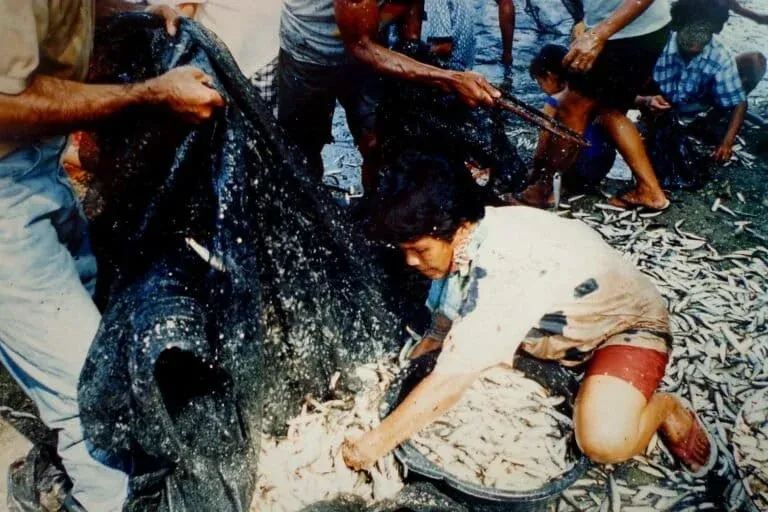
As a way to preserve the sea, the Haruku people have a tradition called sasi lompa. This tradition has been passed down for generations and remains preserved to this day.
Lompa is a type of fish that is abundant in Haruku waters. This tradition is carried out by the kewang led by the Chief Kewang.
"Sasi lompa is a characteristic of Negeri Haruku, as it is not found elsewhere. Sasi lompa is a combination of sea sasi and fish sasi," he said.
"We are familiar with nanaku or reading signs. We will know when the lompa fish should be harvested."
The people of Negeri Haruku will know when lompa enters the river in large numbers after the appearance of young fish called nener. Nener or fish seedlings appear between April and May. That is when the hot sasi begins for three months.
Hot sasi is the process of repeatedly calling the fish to enter the Kayeli River. During this time, the community is strictly prohibited from taking lompa before the sasi is opened.
The hot sasi ceremony takes place at night. All kewang must gather at Baileo Kewang (traditional house for kewang) carrying torches made from bundles of dried coconut leaves or lobe. Lobe is used to make a bonfire. After that, they pray together, then burn the lobe on the kewang stone they call lobe induk.
The kewang group proceeds to the sasi opening location while carrying lobe.
The lobe fire (main torch) is also lit on other lobe that have been prepared at the sasi location. Then there is a burning, indicating the sasi will be opened. After that, the residents can collectively take or harvest the fish.
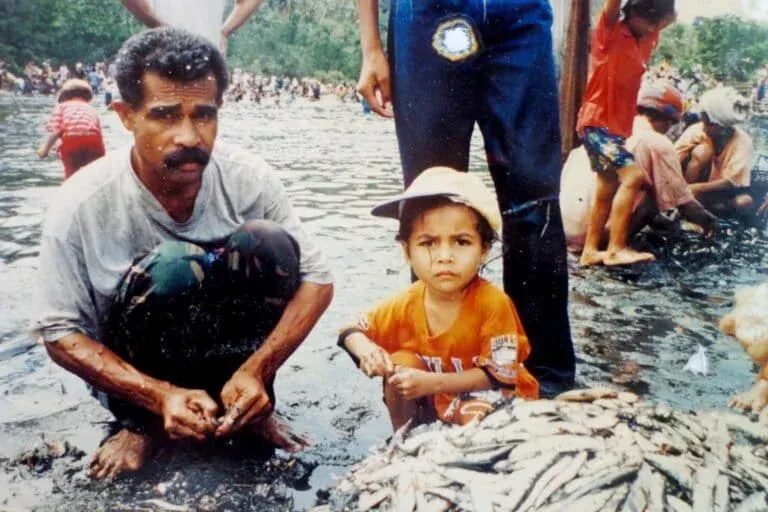
Anyone can harvest. There are no restrictions. The catch must be given to the elderly, widows, and orphans.
"Without having to officially announce it, this sasi sign then automatically regulates the indigenous community in Negeri Haruku. So the river area where lompa is found is also protected," said Opa Eli.
The drum is beaten repeatedly as a symbol of the presence of five soa, community groups consisting of several clans.
"Sirewei…" "Sirewei…" the sound accompanies the drum as a declaration of determination, promise, and oath by the kewang.
There is also kapata or advice from the Chief Kewang to honor the village and the ancestors and declare that the sasi is closed at that time. The traditional sealing ceremony of the river area where lompa enters marks limited human activity in that area.
The sasi lompa sign is kayu buah sasi. This wood comes from a special place called Kayu Raja. There, the sea kewang is determined to protect the sasi area.
According to Opa Eli, lompa fish in the sasi area must not be caught.
Motorboats or speed boats entering the Learisa Kayeli River, he said, must not turn on the engine, nor should kitchen utensils be cleaned or washed in the river. Trash must not be thrown into the river or disposed of in locations designated by the Kewang.
Violators of this customary law will be subject to penalties according to sasi regulations in the form of fines. Violators are also subject to five lashes as a symbol that those who violate sasi rules must bear the burden of the five soa.
Because lompa lives in the river, the daytime temperature of the river must be maintained. One way is by planting mangrove seedlings that provide shelter for fish, including lompa.
This graduate of the people's school (SR) has been planting mangrove seedlings since 2013, which are now thriving.
"I am happy, the results of my planting with fellow kewang of Negeri Haruku are thriving," he said.
Even though the sasi tradition from Negeri Haruku is celebrated with great festivity every year, the community now faces various challenges. There are still practices that damage the environment and greed that sacrifices habitats both on land and at sea still haunt. The perpetrators are not the Haruku community but unknown individuals.
"There is a lot of greed sacrificing coral reefs, bombing activities, and poisoning fish still exist," he said.
Besides disturbances from humans, there are also natural disturbances. High rainfall creates floods, impacting lompa because the fish will not return to the river if it is dirty.
Shift in sasi lompa timing
The implementation of the sasi tradition has shifted. The sasi closing tradition starts in August and the harvest is usually in October. In 2023, the process of closing and opening sasi lompa will only be in January 2024.
"If lompa does not come, then there will be no sasi lompa. No lompa in the Learisa Kayeli River indicates something is wrong. Both with the people and the environment."
There is a shift in harvest time that raises big questions in Opa Eli's mind. In 2024, there is no lompa, until the end of this year, no nener is seen, and sasi lompa cannot take place.
"If in 2023, the harvest should be in October. That means lompa seedlings should be in the Learisa River between June-July until the river is in sasi," said Opa Eli.
What happened, the harvest process became January 2024, the time shifted very far.
Opa Eli suspects that the absence of nener is due to heavy rainfall, so the fish do not want to enter the river.
Another possibility is the impact of climate change. Moh Abdi Suhufan, National Coordinator of Destructive Fishing Watch (DFW) Indonesia, said that the shift in sasi is also likely due to the increasingly apparent impact of climate change. Coastal areas, he said, are vulnerable to the impacts of climate change.
Fishermen are quite affected, including changes in fish seasons and fishing times. Climate change also impacts sea levels, which can submerge islands, land, and settlements.
Therefore, he said, responsible, sustainable, and equitable coastal and marine management based on human rights is needed.
The steps that must be taken, he said, are to encourage and strengthen fair public policies in coastal management. Also, to promote responsible coastal and marine oversight in a synergistic and collaborative manner, oriented towards human rights.
"Strengthening and empowering fishermen, fishery workers, and civil society in sustainable coastal and marine management."
Jean Carlla Warella, a graduate of Pattimura University, Faculty of Teacher Training and Education, in her research explains that there are several factors influencing the presence and density of lompa, such as biotic factors like plankton (phytoplankton and zooplankton) and abiotic factors like temperature, salinity, current speed, and water clarity.
In her 2012 research, Warella wrote that the Learisa River is a habitat for lompa. The reason is that in the middle of the river, the surface water temperature ranges from 25°C-29°C with an average of 26.17°C-28.17°C. Meanwhile, in the river branches, the water temperature ranges from 27°C-30°C with an average of 28°C-28.97°C.
However, the water temperature in the Learisa River can increase if the water volume decreases during low tide and impacts the increased penetration of sunlight into the river. Warella concluded that the Learisa condition is still suitable for the cultivation of marine biota, especially lompa (Thrissina baelama).
Warella's research states that current speed is also an important factor in the adaptation process of Thrissina baelama, both weak and strong currents.
Current speed is a very beneficial transportation medium for lompa because the current carries oxygen and food materials for biota that inhabit mud, sandy mud, and creeping animals on the waterbed.
This condition accelerates the sedimentation process due to an imbalance in sandy or muddy waterbed conditions.
Based on research results, water clarity affects the survival of lompa because the Learisa estuary has relatively low clarity. This may be due to the degradation (decline) of the Learisa-Kayeli River, causing sedimentation to accumulate at the river mouth.
Lompa legend
Lompa, he said, can live in both seawater and rivers. The Haruku people also know this type as sardine fish.
Lompa lives in river water from 04:00–18:30, then from 18:31-05:00, the fish will move to the sea to feed. At dawn, it returns to the river.
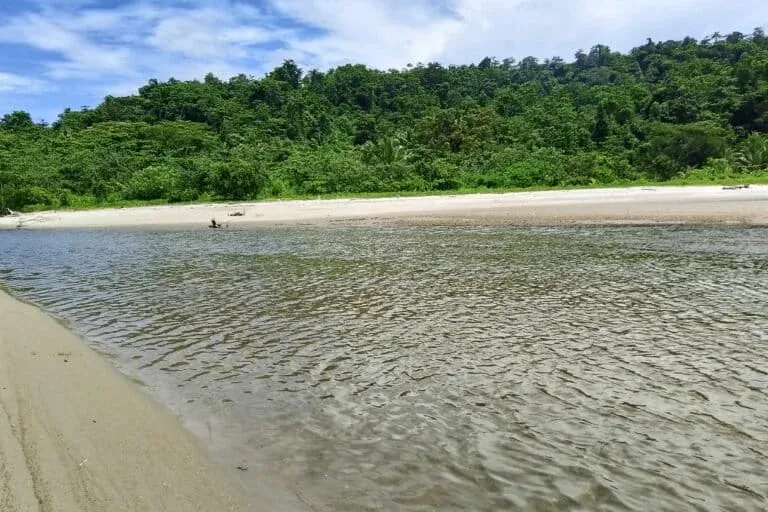
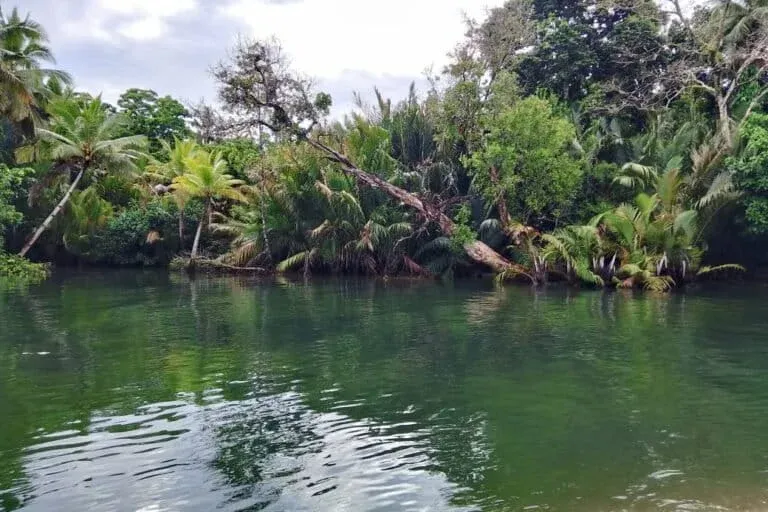
In Haruku, the river that is the habitat for lompa is the Learisa Kayeli River. Lompa can enter the river or stream up to 1,500 meters from the estuary.
"It is not yet certain where this fish spawns to produce new generations, as researchers from Pattimura University have not yet found a definite answer," said Opa Eli.
In the river where lompa lives, there is a mangrove forest that the community protects and plants, including Eli since childhood.
He tells a legend that the Haruku community still believes in, that lompa in Haruku waters is a gift.
The legend begins with a battle between the Learisa Crocodile, a reptile inhabitant of the river or Learisa Kayeli River, fighting with a snake at Tanjung Sial, Seram Island.
The Learisa Crocodile managed to defeat the snake and received a gift of make fish, parang-parang, and lompa. The parang fish was then left by the crocodile in the waters of Negeri Passo, Ambon Island, Baguala Bay Area.
In short, even though it killed the snake, the crocodile was seriously injured. On the way back to Haruku, the crocodile stopped by Negeri Waai, at the foot of Mount Salahutu, Salahhutu District, Central Maluku. The crocodile was about to be killed by the residents of Negeri Waai.
The crocodile is believed to be able to talk to humans. The Learisa Crocodile asked not to be killed. However, the residents took a stick and stabbed it into the belly of the Learisa Crocodile, which was pregnant at the time.
Immediately, the Learisa Crocodile gave birth. Its child is the one who brought make and lompa to Negeri Haruku.
"This story has been passed down that lompa is a gift and needs to be preserved. In the past, there was make fish, now it is gone," he said.
Learning from the loss of make in the waters of Negeri Haruku, the community is determined to continue the sasi lompa to keep it preserved.
"Very unique. Lompa fish when in the sea can go anywhere, but cannot go to other rivers, only to the Learisa Kayeli River. That is our belief."
Guardians of nature
The Haruku community loves nature and is also its guardian. In 1985, the Haruku community even received the Kalpataru award for their protection practices from land to sea through the sasi system. However, sometimes they are powerless when there are threats of marine damage, due to limited human resources, especially when conflicting with powerful parties.
"We protect, but others destroy, there is legal action even reaching court, but problems still arise."
The condition at sea, he said, is not completely safe, there are still practices of environmentally unfriendly fishing. The upstream river is also a support for lompa life.
"The impact is on lompa because at night the fish are at sea. If there is a surviving group, they will move up the river," he said.
He also advised that river conservation needs to continue. With that awareness, he said, it can become a strength so that residents no longer use the river as a place to dispose of waste or household trash. If the river water is dirty, he said, lompa will not enter the river.
Klif Kissya from the Indigenous Peoples Alliance of the Archipelago (AMAN) Lease said that efforts to preserve the river and sea in Negeri Haruku begin with providing an understanding of the importance of protecting the environment. Also, the annual sasi lompa tradition, he said, is an action that revitalizes conservation practices in the community.
"If the Learisa Kayeli River remains protected, the sea must also be protected. To keep the Larissa River sustainable, the forest area upstream and along the edges must also be protected," said Klif, son of Eliza Kissya, the environmental warrior of Haruku.
He said that kewang in Negeri Haruku at least still acts as a barrier to destructive forces. However, there are still issues like the climate crisis impacting weather conditions.
Negeri Haruku is part of a series of small islands and has 11 traditional villages or adat villages that are geographically located on the North and South Coast of Haruku Island with an area of 150 km². Negeri Haruku borders Negeri Oma and Negeri Sameth.
The residents of Negeri Haruku depend on marine and forest products as well as long-term plantation crops, such as cloves, nutmeg, langsat, and durian. In the marine sector, some become fishermen or motorboat drivers.
In 2018, this village experienced tidal flooding. The sasi lompa conservation area was damaged. Several wave-breaking embankments were damaged, now repaired.
"There was once mangrove planting on the coast of Negeri Haruku but it failed because waves and tides swept away the mangrove seedlings. Except on the edges of the Learisa River," said Kliff Kissya.
Agus Kastanya, an academic from Pattimura University (Unpatti) Ambon, said that small islands like the Haruku Archipelago have characteristics and short river basin (DAS) characteristics. If management is not environmentally friendly, he said, it will eventually lead to disaster.
With short DAS conditions, especially if forest cover is open, the environment will be destroyed and the impact will be felt in coastal and marine areas.
With this climate crisis, there is also a threat to small islands, such as rising sea levels, increasing temperatures, and tropical storms that can trigger coastal erosion.
"The condition of small islands with all limited carrying capacity, management, and utilization must maintain the ability and carrying capacity of the environment."
***
Opa Eli's voice began to tremble, the sound of his beloved ukulele strings creating the rhythm of the G chord opening a song that entertains. The title of the song is genealogy in the old house.
Dense forest called ewang,
mismanaged no ampong,
because of the legacy of the kewang chief,
I am willing to stay in the village,
"Come sit on the deck,
while sitting we eat.
Because of love for the environment,
I often forget my children and wife.
A joyful expression radiated from the wrinkled face. The environmental warrior, Opa Eli, recited a poem about preserving the values that are the heritage of the Haruku people.

Join Our Newsletter
Berlangganan buletin kami untuk mendapatkan pembaruan terbaru, berita, acara, dan aktivitas komunitas langsung ke kotak masuk Anda.
We respect you privacy, your email is safe with us.