Aligning Actions for Synergy: Climate, Biodiversity, and ICCAs Practices
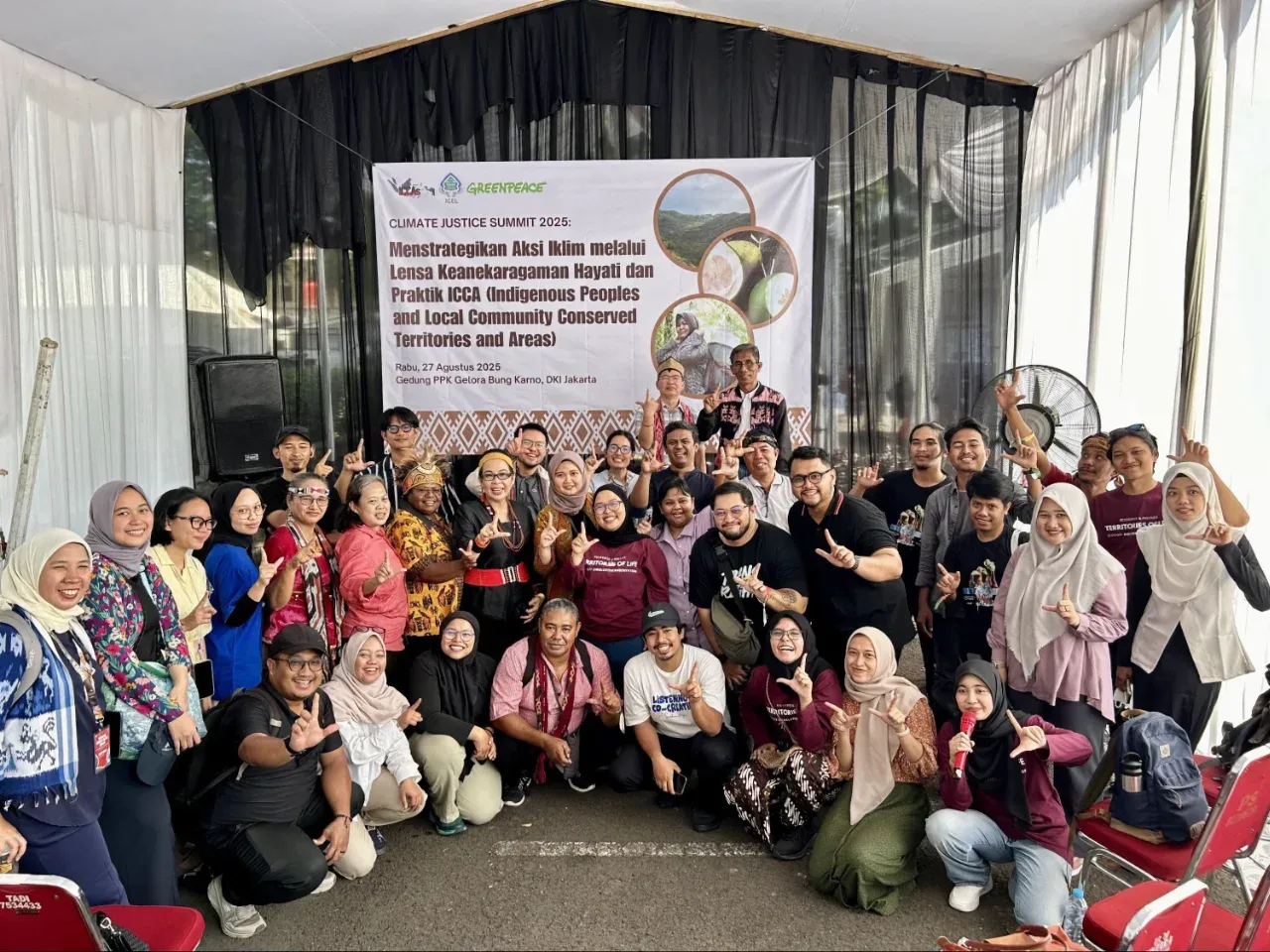
Last Wednesday, the Working Group ICCAs Indonesia (WGII) participated in the Climate Justice Summit 2025 to hold a side event at the PPK Building, Gelora Bung Karno, DKI Jakarta. Titled "Strategizing Climate Action through the Lens of Biodiversity and ICCAs Practices (Indigenous and Community Conserved Areas and Territories)", WGII conducted a discussion moderated by Hans Nicholas Jong from Mongabay Indonesia, with speakers in related fields, including Amin Abdullah - Fishermen Resource Development Institute (LPSDN); Anggi Pertiwi Dewi - Directorate of Environment, Ministry of National Development Planning/National Development Planning Agency of the Republic of Indonesia (BAPPENAS); Cindy Julianty - Executive Coordinator of the ICCAs Indonesia Working Group (WGII); Syahrul Fitra - Senior Forest Campaigner, Greenpeace Indonesia; and Syaharani - Head of Climate Justice and Decarbonization Division, Indonesian Center for Environmental Law (ICEL).
This discussion was a collaboration between WGII, Greenpeace Indonesia, and ICEL. Approximately 30 participants joined. In the discussion, Mr. Amin from LPSDN shared about local cultural practices in his area, namely awik-awik. It is a set of customary rules in the aquatic area, which also manages the sustainability of the sea and the livelihood of fishermen, specifically in Teluk Jor, East Lombok Regency, West Nusa Tenggara. Awik-awik is recognized from the village, sub-district, to the local district level, through the management of mangroves, shrimp ponds, and so on. Since 2013, destructive activities have decreased with the implementation of awik-awik. However, it faces regulatory challenges due to marine decentralization where villages lose formal legitimacy to manage the sea; according to Law No. 23/2014.
Additionally, Cindy Julianty as the Executive Coordinator of WGII, explained that the Rio Convention, which resulted in three global agreements, needs to prioritize the principle of collaboration where when discussing climate, we cannot separate the other two conference outcomes because the impact of the climate crisis clearly reaches down to the smallest species unit. Moreover, how to manage ecosystems sustainably without touching on the issue of tenure rights within them? This certainly requires a Human Rights-based approach, recognizing the rights of Indigenous Peoples and Local Communities as one of the stakeholders in conservation practices.
Syaharani (ICEL) also added that we can use the momentum of COP30 as an opportunity to push biodiversity issues and other related climate issues, for instance, to respond to the global climate funding commitments ratified at COP29. Besides, "we need to look at and reflect on the efforts already made by the government," said Anggi Pertiwi (BAPPENAS). And certainly, there is a gap that needs to be filled together, whether through meaningful involvement of Indigenous Peoples, program implementation with local networks, or other programs that can involve a number of related rights and interest holders. There is also a national priority that is specifically aimed at protecting existing conservation practices, so this discussion can spark further collective work, to demonstrate the role and culture of biocultural conservation within the framework of Indigenous Peoples and Local Communities.
The opportunity for resource mobilization in Target 19 of the GBF (Kunming-Montreal Global Biodiversity Framework) also needs to be an important basis in promoting funding allocation from developed countries and protecting biodiversity in Global South countries. Syahrul (Greenpeace) stated that he also sees direct funding alternatives supporting Indigenous Peoples at COP30. Therefore, this discussion is expected to bridge strategic issues to the government and the general public, particularly regarding biodiversity protection, Community Conserved Areas (ICCAs), global and regional policies governing related issues, and direct funding opportunities. Additionally, this is an opportunity for us to review how stakeholders can embrace a number of aspirations and strengthen joint actions ahead of COP30. One of them is to learn conservation practices rooted in traditional knowledge and respect for Human Rights.

Join Our Newsletter
Berlangganan buletin kami untuk mendapatkan pembaruan terbaru, berita, acara, dan aktivitas komunitas langsung ke kotak masuk Anda.
We respect you privacy, your email is safe with us.