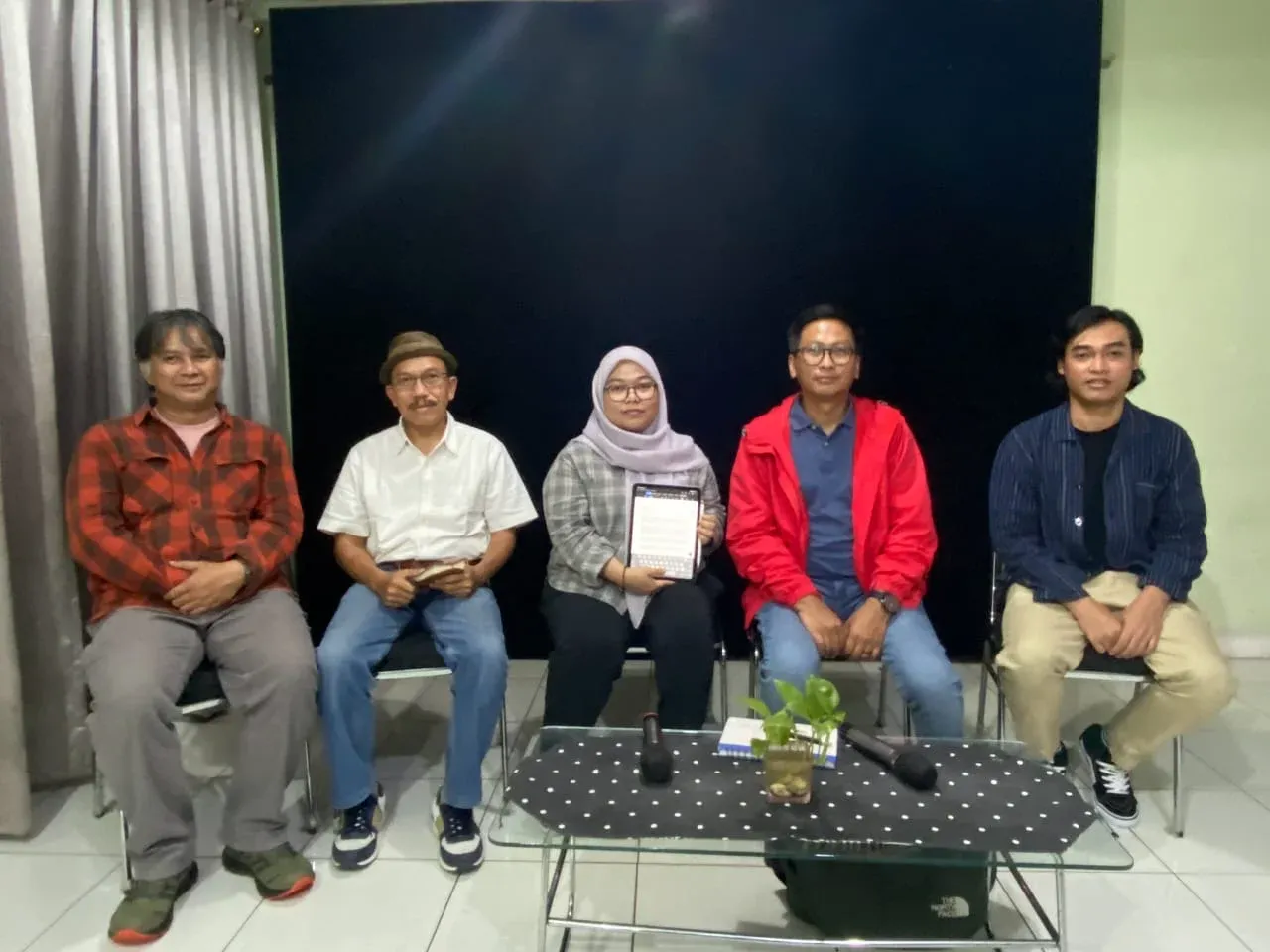
Civil Society Defenders of Human Rights and Indigenous Peoples Express Rejection of the Ratification of the KSDAHE Bill
Friday, January 19, 2024, at the Walhi office - Jakarta, Civil Society Defenders of Human Rights and Indigenous Peoples delivered an open letter to the KSDAHE Bill Working Committee in response to the KSDAHE Bill legislation, after more than 8 years of the Conservation Bill going in and out of the national legislative program. Previously, civil society had submitted substantive input on the KSDAHE Bill in the form of policy briefs, Problem Inventory Lists (DIM), and key recommendations article by article. Unfortunately, the civil society coalition believes that, until the last draft received in December 2023, there has been no positive material or formal change in the KSDAHE Bill legislation process. Walhi, AMAN, KIARA, BRWA representing civil society dissected crucial points that remain problematic into an Open Letter to assert the stance and position of civil society.
"There are 3 (three) reasons why we reject the ratification and urge the postponement of the KSDAHE Bill, and demand that the government not rush in ratifying the KSDAHE Bill. First, the KSDAHE Bill legislation process is not transparent and participatory (meaningfully participated), especially in the formulation of articles. This is evidenced by the absence of documents on the website (dpr.go.id) related to legislative discussions. Second, our proposals regarding aspects of public participation, protection, and recognition of the rights of indigenous peoples and local communities are not accommodated. Third, we actually found problematic articles, and open up more potential for criminalization, discrimination, neglect of rights against indigenous peoples and local communities living in and around conservation areas," emphasized Cindy Julianty (Representing BRWA)
Substantive Issues of the KSDAHE Bill
Satrio (Manager of Legal and Policy Studies) stated, "we see that conservation issues have not become a concern for policymakers, even though this is an important issue to address the challenges of climate change and the ecosystem crisis today. This can be seen from the absence of this issue from the 2024 presidential debate material. In terms of substance, the KSDAHE Bill also uses a repressive approach to ensure that conservation activities run. This is evident from the forms of sanctions and criminalization that are more oriented towards imprisonment. Whereas conservation crimes have economic motives, so they should emphasize fines and asset confiscation, these criminal sanctions are also not aimed at corporations but individuals, thus opening up more potential for criminalization."
Furthermore, Satrio assessed that the KSDAHE Bill has a conservation paradigm that tends to see indigenous peoples and local communities as threats rather than partners who contribute to conservation management, resulting in the state's approach actually re-emerging conflicts and excluding communities from their living spaces.
Another critical point was conveyed by Moehammad Arman (Director of Policy Advocacy, Law & Human Rights – AMAN) "We know that we are facing the problem of conservation management today that is not based on human rights and neglects the rights of indigenous peoples. We observe that this KSDAHE Bill also does not change the status quo, meaning there is no positive change. This is evidenced by the absence of meaningful participation and consent based on free prior and informed consent (FPIC) in the establishment of conservation areas. We know many criminalization cases occur because the state does not pay attention to this aspect. For example, the case in Colol known as Bloody Wednesday which resulted in 6 people dead, 28 people injured, and 3 of them permanently disabled. Thus, it is a mistake if the Bill does not regulate aspects of rights and participation. Whereas 75% of indigenous territories are included in forest areas where 1.6 million hectares of territory included in conservation have a population of about 2.9 million people."
This Bill also has problematic articles related to Preservation Areas (Article 8 paragraph) which are unclear and do not address the demand to recognize other conservation actors outside the state. Although it mentions AKKM and Local Wisdom Protection Areas, the preservation designation seems only oriented towards expanding conservation areas alone without considering aspects of rights and benefit distribution. This is emphasized in Article 9 paragraph (1) which narrows the scope of preservation areas to merely maintaining the protection function of the area by conducting conservation actions, where if the permit holder in the area does not conduct conservation actions, it will result in the sanction of land rights release.
Kasmita Widodo, Head of BRWA, highlights the relevance of recognition and protection of indigenous territories and customary forests in the KSDAHE Bill. "A year ago, we had hope (draft KSDAHE Bill 2022), there would be positive changes that could protect the community and recognize the community's contribution to biodiversity conservation. However, instead of improving conservation policies to be more inclusive, this KSDAHE Bill will actually undermine Constitutional Court Decision 35/2012 and impact the struggle of Indigenous Peoples to reclaim their rights over their territories and customary forests. We know that we experience difficulties in proposing customary forests in conservation areas, the provisions regarding the prohibition of reducing areas in Nature Conservation Areas will further strengthen centralistic conservation policies."
"KIARA views, this Bill could be a threat to the seizure of coastal and marine areas or Ocean Grabbing, so the KSDAHE Bill could fulfill the Ministry of Marine Affairs and Fisheries' ambition to achieve the 30 by 30 target which relies on expanding Conservation Areas which in fact continues to perpetuate conservation that has actually failed to carry out nature and marine preservation. Whereas the best practices are in the community, not only carried out by the state, it is these practices that should be accommodated and recognized by the state as a community contribution to achieving this with the community's own way," continued Erwin Suryana (Deputy Program and Knowledge Management KIARA)
Erwin also stated that the KSDAHE Bill has not led to an inclusive conservation model but instead opens up space for the private sector (investors) to work more deeply in conservation areas wrapped in the name of Environmental Services to perpetuate the process of capitalization or capital accumulation.
Civil Society Demands
"The results of our call with civil society organizations and indigenous peoples and human rights defenders networks concluded that the KSDAHE Bill fails to realize an inclusive, fair, rights-based, culturally and uniquely archipelagic conservation policy transformation. We reaffirm our position on the KSDAHE Bill legislation in the open letter that we will submit to the KSDAHE Bill Working Committee," said Cindy Julianty conveying the conclusion.
The complete Open Letter on the Stance and Position of Civil Society for the KSDAHE Bill Legislation can be accessed at: https://iccas.or.id/publikasi/read/538
The Press Conference broadcast can be accessed on the YouTube channel: https://youtube.com/live/iazItO9gNBA?feature=share
Contact:
Asti Noor (0813 8860 1039)

Join Our Newsletter
Berlangganan buletin kami untuk mendapatkan pembaruan terbaru, berita, acara, dan aktivitas komunitas langsung ke kotak masuk Anda.
We respect you privacy, your email is safe with us.