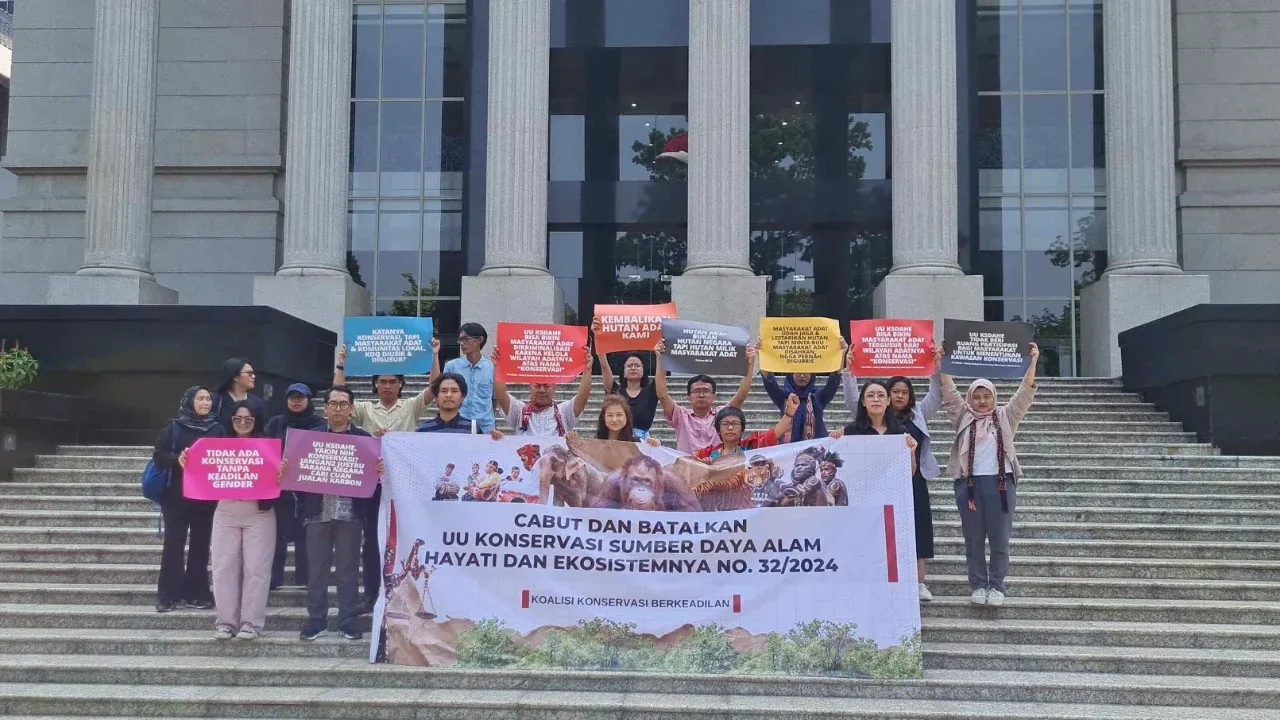
Constitutional Court Rejects Formal Review Request by Indigenous Peoples and Local Communities Regarding the Conservation Law: Public Participation Becomes Increasingly Meaningless
PRESS RELEASE
ADVOCACY TEAM FOR FAIR CONSERVATION
Jakarta, July 17, 2025 – The Constitutional Court of the Republic of Indonesia rejected the formal review request of the Law on the Conservation of Biological Resources and Their Ecosystems (Conservation Law) submitted by three civil society organizations and representatives of indigenous peoples. This decision is a setback in the recognition and protection of indigenous peoples and local communities in conducting conservation based on traditional knowledge and local wisdom.
The four applicants are the Indigenous Peoples Alliance of the Archipelago (AMAN), the Indonesian Forum for the Environment (WALHI), the People's Coalition for Fisheries Justice (KIARA), and Mikael Ane, a member of the Ngkiong Manggarai Indigenous Community, NTT, who became a victim of criminalization. The request for judicial review of the law is registered under Case Number 132/PUU-XXII/2024.
The Process of Forming the Conservation Law Was Closed But Not Problematic and Justified by the Constitutional Court
The Constitutional Court, in its legal considerations, acknowledged that out of 21 (twenty-one) meetings at the First Level Discussion and 1 (one) meeting at the Second Level Discussion in the discussion stages, only 4 (four) meetings were held openly, while the remaining 18 (eighteen) meetings, including the Drafting and Synchronization Team meetings, were held in private.
The Constitutional Court even stated that although the meetings were declared closed, the public could still know the discussions in the meetings through meeting notes, either the entire or part of the content of the discussions. However, monitoring results from the Civil Society Coalition for Fair Conservation found 20 meeting process documents that were inaccessible.
Demanding Fair and Participatory Legislation
Coalitions of indigenous peoples, civil society organizations, and academics call for future legislative processes to comply with the principle of Meaningful Participation, especially on issues related to the environment, land, and natural resources.
"We appreciate the Constitutional Court's decision regarding the formal review of the Conservation Law that we requested. However, for us, involving the community, especially Indigenous Law Communities in the RDPU, is not enough to ensure the aspect of meaningful participation in the formation of the Conservation Law. Moreover, our experience during the advocacy process of the Conservation Law, meeting result documents and draft laws were not easy to obtain, as proven in previous court proceedings, and we also did not receive sufficient explanations from the lawmakers regarding various problematic articles in the law. We will continue to monitor this law," emphasized Cindy Julianty, Executive Coordinator of the ICCAs Working Group Indonesia.
This Constitutional Court decision sets a bad precedent for future legislative processes and increasingly sidelines the voices of vulnerable and directly affected groups, especially indigenous peoples and local communities. This decision reinforces the position of indigenous peoples as legal subjects entitled to be actively involved in every policy that impacts their living space, culture, and livelihoods.
"With this formal review request, the government and the DPR must start reorganizing an inclusive, democratic legislative process that respects the existence of Indigenous Peoples as guardians of forests and biodiversity, as emphasized by the Constitutional Court in this decision that lawmakers must maximize meaningful full involvement of the community," said Syamsul Alam Agus, S.H., the applicant's legal counsel who is part of the Advocacy Team for Fair Conservation.
"This Constitutional Court decision contains a paradox clearly depicted in the considerations section, because on one hand it rejects but on the other hand suggests lawmakers maximize participation in law formation through information technology, making it clear that the Constitutional Court's considerations for rejecting this request are not solid and tend to be hesitant in deciding the case," said Teo Reffelsen, Legal and Defense Manager of WALHI.
In line with this, the Secretary General of the People's Coalition for Fisheries Justice (KIARA) stated that:
"This Constitutional Court decision adds to the long history of law formation that ignores the principles of openness and public involvement or does not involve full, real, and meaningful participation (Meaningful Participation) from indigenous peoples and local communities living in coastal areas and small islands. This is also in line with the dissenting opinion of two Constitutional Court Judges who stated that there was a neglect of the principles of openness and public involvement in realizing the principle of Meaningful Participation in the drafting of the Conservation Law. Justice for all indigenous peoples and local communities to be meaningfully involved in the drafting of laws and regulations should be upheld by the Constitutional Court," emphasized Susan.
The Secretary General of the Indigenous Peoples Alliance of the Archipelago (AMAN), Rukka Sombolinggi, stated that the absence of full and effective participation will make this law lose its legitimacy in the eyes of indigenous peoples.
"This law may be considered legal by policymakers, and the Constitutional Court by stating it has met the formal requirements of law formation. But for us, indigenous peoples, the process of forming the Conservation Law and this Constitutional Court decision do not reflect full and effective participation. This is in line with the trial facts stating that out of 21 discussions, only two were open to the public. Even then, the input from indigenous peoples and civil society was not accommodated. In our view, indigenous peoples, this Conservation Law is legal but not legitimate," said Rukka.
Dissenting Opinion of Constitutional Court Judges: This Request Should Have Been Granted
There is a dissenting opinion from two Constitutional Court Judges, namely Constitutional Judge Suhartoyo and Constitutional Judge Saldi Isra. Both judges stated that the process of forming Law 32/2024 was discussed in closed meetings, resulting in difficulties for the public to know the information on the progress of the draft law discussions.
Such facts cannot be justified and should not be taken lightly in the law formation process. Because the essence of the dialogical process in the principle of Meaningful Participation cannot be realized in the discussion of draft laws conducted in private. This clearly violates the principle of openness in the law formation process.
In this case, both judges emphasized that openness in the discussion stage is the culmination point of the realization of public participation in the law formation process.
Both Constitutional Court Judges also emphasized that because there are facts that the discussion process of Law 32/2024 was conducted in private without valid reasons, impacting the neglect of the principles of openness and public involvement in realizing the principle of Meaningful Participation, the Constitutional Court should have declared that Law 32/2024 contains formal defects so that its formation process contradicts the 1945 Constitution of the Republic of Indonesia.
Thus, the main request of the applicants is considered legally justified. Or, at least, the Constitutional Court should have granted part of the applicants' request.
Contact:
Syamsul Alam Agus, S.H. – 08118889083
Original Document of the Press Release from the Advocacy Team for Fair Conservation

Join Our Newsletter
Berlangganan buletin kami untuk mendapatkan pembaruan terbaru, berita, acara, dan aktivitas komunitas langsung ke kotak masuk Anda.
We respect you privacy, your email is safe with us.