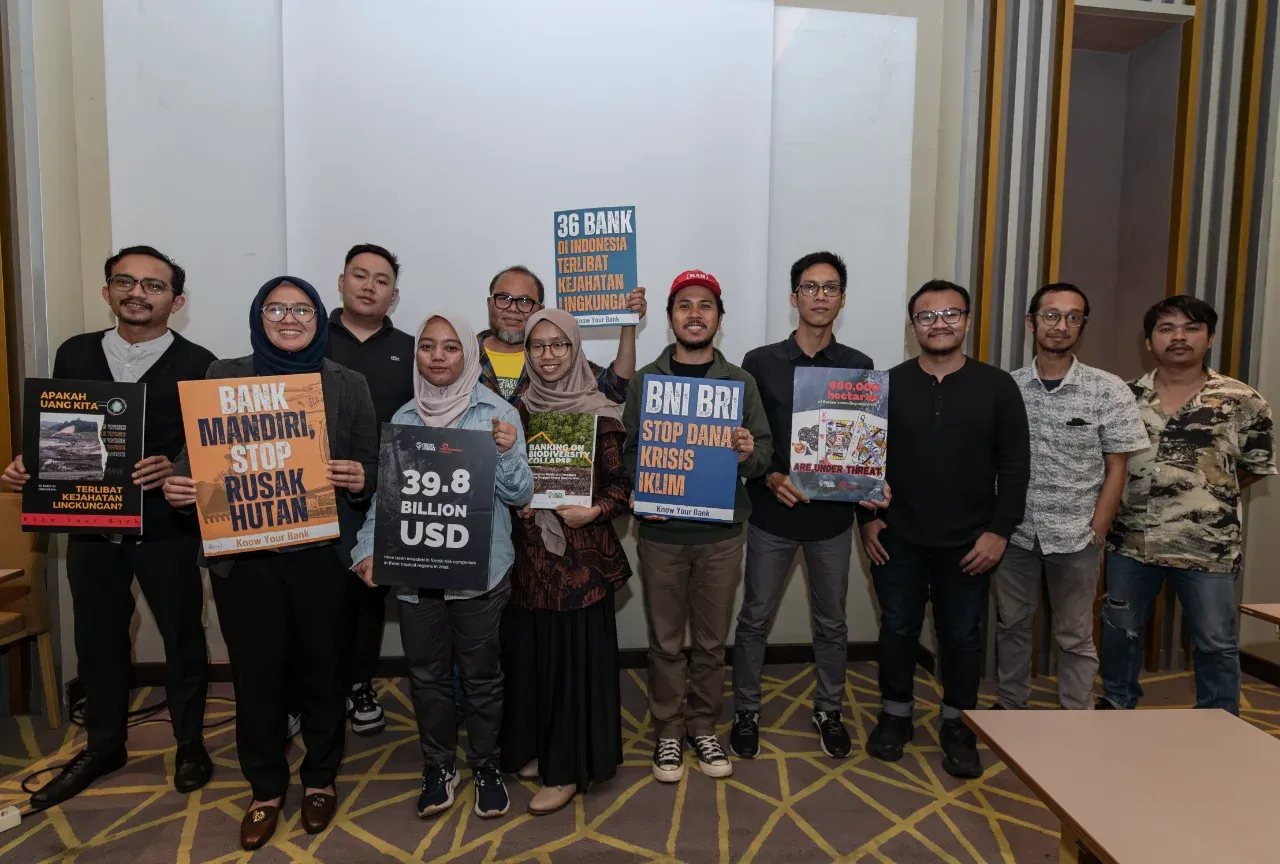
Major banks in Indonesia contribute to funding forest destruction and biodiversity loss
Jakarta, March 27, 2024, Tuk Indonesia together with the Forest and Finance coalition released the report Banking on Biodiversity Collapse. The report reveals that banks play a role in driving biodiversity loss and climate change because they have provided funding to forestry and agribusiness sector companies whose commodities are at risk of losing tropical forests in Indonesia.
"Based on market capitalization as of June 2023, these banks provided funding of around USD 30.5 billion or about 40% of total credit for palm oil, pulp & paper, timber, and rubber companies operating in Indonesia," said Linda Rosalina, Executive Director of TuK INDONESIA.
She added that "Bank Mandiri, BCA, BRI, and BNI are at the top as the largest banks in Southeast Asia that risk forests in Indonesia. And the largest credit recipient is the Sinar Mas Group (SMG), the controller of Asia Pulp & Paper and Golden Agri Resources. This is identified as receiving 38% of the disbursed credit."
According to the report, pulp plantation concessions have contributed emissions of 103 million tons of CO2 per year, equivalent to 7% of Indonesia's total national emissions in 2020. This means that the flow of funding provided by banks to emission-contributing companies has also contributed to climate change. It is also known that these companies have a track record of human rights violations, including the seizure of indigenous peoples' territories.
Based on Pusaka's documentation, there are 20 palm oil company groups that control large-scale plantation land in Papua. One of them is the Korindo group or Tunas Sawa Erma Group (renamed since 2021) which controls 148,652 ha of land through seven companies. Franky Samperante, Director of Pusaka, assessed that "investment entering Papua has led to the widespread conversion of customary forest areas into commercial commodity business areas and the transfer of control and ownership of land and forests to a handful of investors, displacing the existence and rights of indigenous peoples."
Franky commented on the irony of the climate change phenomenon happening today, stating that "companies exploiting natural resources have contributed to deforestation and biodiversity loss, yet they receive profitable financing from financial institutions to develop new businesses, namely carbon trading."
This Banking on Biodiversity Collapse report is evidence that the environmental, social, and governance (ESG) policies of major banks in Indonesia are still lagging behind and failing to prevent forest and biodiversity loss. This is certainly counterproductive to Indonesia's commitments to the Paris Agreement and the Kunming-Montreal Global Biodiversity Framework, where Indonesia has set ambitious targets to halt and restore forest loss, land degradation, and biodiversity loss.
Read also: Policy Brief: Considering the Kunming - Montreal Global Biodiversity Framework to support rights-based conservation approaches and conservation practices by indigenous peoples in Indonesia
#AN

Join Our Newsletter
Berlangganan buletin kami untuk mendapatkan pembaruan terbaru, berita, acara, dan aktivitas komunitas langsung ke kotak masuk Anda.
We respect you privacy, your email is safe with us.