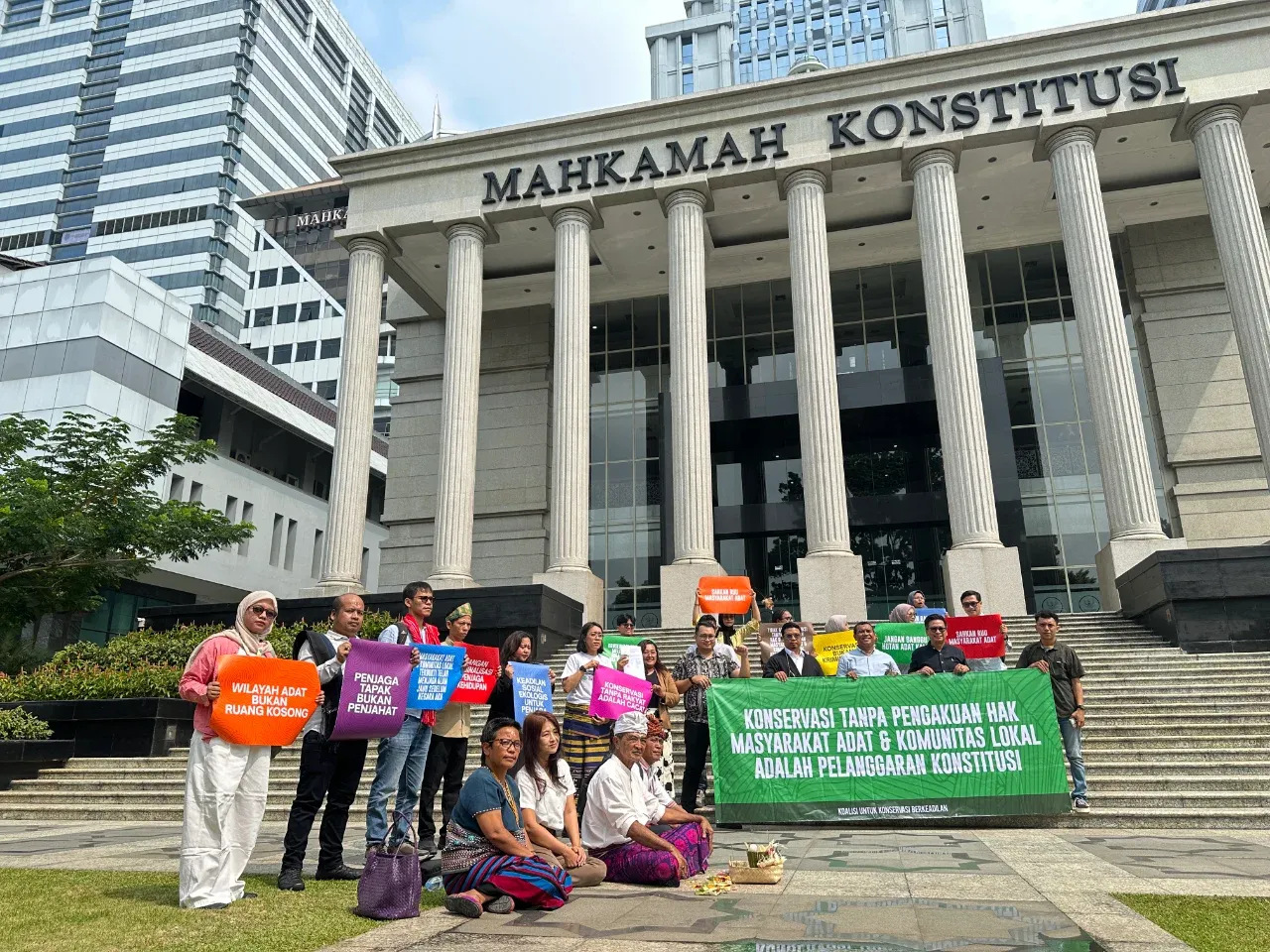
Press Release: Indigenous Peoples and Local Communities Challenge Conservation Law at the Constitutional Court: Conservation Must Not Criminalize the Guardians of Nature
by: Koalisi untuk Konservasi Berkeadilan
Jakarta, July 8, 2026. The Coalition for Just Conservation, consisting of civil society organizations together with representatives of Indigenous Peoples and local communities, filed a material judicial review of Law Number 32 of 2024 on Amendments to Law Number 5 of 1990 concerning Conservation of Living Natural Resources and Their Ecosystems to the Constitutional Court, following the rejection of a formal review of the same law.
This material review targets provisions considered likely to preserve a centralistic approach to conservation, restrict community access to their living spaces, disregard local governance and knowledge, and open the door to criminalizing traditional practices that are, in fact, part of efforts to protect nature.
This material review was filed after an earlier formal review, which challenged the process by which Law 32/2024 was enacted, was rejected by the Constitutional Court. With the formal route now closed, the Coalition is pursuing a material review to challenge the content of provisions that directly affect the rights of Indigenous Peoples and local communities. The problematic articles in Law 32/2024 are considered unchanged and still likely to harm communities in customary territories, managed areas, coastal zones, small islands, and conservation areas.
From Customary Territories and Coastal Areas to Conservation Zones
The petitioners in this case are the Indigenous Peoples' Alliance of the Archipelago (AMAN), represented by Secretary General Rukka Sombolinggi; the People's Coalition for Fisheries Justice (KIARA), represented by Secretary General Susan Herawati Romica; along with Rukmini P. Toheke from the Ngata Toro Indigenous Community, Central Sulawesi; Bambang Zakariya from the Karimunjawa maritime community, Central Java; Herman Sarira from the Pali Indigenous Community, Tana Toraja, South Sulawesi; Putu Ardana from the Dalem Tamblingan Indigenous Community, Bali; and Maksi Kornelis Liem from the Mollo/Mutis Indigenous Community, East Nusa Tenggara.
The five individual petitioners bring direct experience from customary and managed territories that overlap with state conservation areas, including Lore Lindu National Park, Karimunjawa National Park, state forest areas in Tana Toraja, the nature reserve in Dalem Tamblingan, and Mutis Timau National Park.
Conservation Must Not Ignore Community Rights
AMAN Secretary General Rukka Sombolinggi asserted that the Law on Conservation of Living Natural Resources and Ecosystems (KSDAHE) still carries a centralistic view of conservation and does not position Indigenous Peoples as the primary subjects in nature protection.
"At an international forum, an Indigenous person testified that they were evicted because their territory was designated as a high conservation value area. Before that forum, they said: perhaps if we were animals, we would not have been evicted, because in this country, in the name of conservation, animals are valued more than people. That is why, from the start, AMAN has intervened in the drafting of this law, because the law is centralistic and does not take into account customary territories or the conservation practices of Indigenous Peoples," said Rukka.
Rukka also stressed that pitting humans against wildlife reflects a flawed view of conservation.
"A global academic panel study has, since 2020, reported that 80 percent of the best remaining ecosystems today are protected by indigenous peoples. So pitting humans against wildlife is actually irrelevant. Indigenous Peoples are in fact the best guardians of nature. In reality, many areas claimed as national parks have been damaged, allowed to be encroached upon by oil palm plantations, and even contain illegal mining. Meanwhile, areas protected by Indigenous Peoples remain well preserved," she affirmed.
Meanwhile, KIARA Secretary General Susan Herawati Romica argued that the provisions on preservation areas, prohibitions on activities in nature sanctuary zones, and a community role limited to being "directed and mobilized" by the government are deeply problematic, both in principle and in practice.
"The provisions on Preservation Areas, prohibitions on activities in Nature Sanctuary Areas, and a community role that is only directed and mobilized by the Government, are, both normatively and in implementation, highly problematic. Maritime communities who manage and utilize their territories are highly vulnerable to criminalization, especially those critical of conservation area managers. The management of coastal areas and small islands by maritime communities is an expression of human rights guaranteed by the constitution," Susan explained.
Indigenous Peoples Have Protected Nature for Generations
From Bali, Putu Ardana of the Dalem Tamblingan Indigenous Community said that customary communities have long protected their territories through customary rules, knowledge, and practices. Yet the state often arrives instead with a uniform conservation concept that disregards the existence of these communities.
"For decades, customary communities have proven they protect their territories. It is the state that comes in with this uniform conservation concept that actually causes damage. Because of the lack of strong recognition for Indigenous Peoples, that absence is instead used by the government as a justification for actions that damage nature and the Indigenous Peoples' living space," said Putu.
Herman Sarira of the Pali Indigenous Community, Tana Toraja, South Sulawesi, also said that the existence of this law creates fear among communities living in areas designated as conservation zones.
"With this law in place, we feel deeply threatened and our livelihoods have been disrupted. Even building a house makes people afraid, because their territory has already been marked out as a conservation area," Herman said.
The experiences of these Indigenous Peoples and local communities show that the issue with the KSDAHE Law is not merely a matter of legal norms, but also concerns the sustainability of living spaces, livelihoods, local knowledge, and conservation practices that have been carried out for generations.
Preservation Areas, Prohibited Activities, and the Role of Communities
In their petition, the Petitioners are challenging Article 1 Point 16, Article 19 Paragraphs (1) through (3), Article 33 Paragraphs (1) through (3), and Article 37 Paragraph (1) of Law 32/2024 against the 1945 Constitution.
Article 1 Point 16, concerning Preservation Areas, is considered likely to become a new instrument for designating conservation areas over customary territories without adequate recognition. Articles 19 and 33 are considered problematic because the phrase "every person" fails to distinguish between environmental destroyers and corporations on one hand, and Indigenous Peoples and local communities who have lived in their territories for generations on the other. As a result, activities such as farming, cultivating fields, herding livestock, gathering non-commercial forest products, traditional fishing, or performing customary rituals could potentially be criminalized.
Meanwhile, Article 37 Paragraph (1) is being challenged because it positions the community's role merely as a party that is "directed and mobilized" by the government, rather than as a sovereign subject over its own territory, knowledge, and governance systems.
The KSDAHE Law Strengthens State Control in the Name of Conservation
Viktor of the Petitioners' Legal Team explained that the definition of Preservation Area in the KSDAHE Law forms an essential basis for the entire set of provisions concerning preservation areas.
"Article 1 Point 16 of the KSDAHE Law, as the general provision defining Preservation Area, is the spirit underlying all articles governing Preservation Areas. This definition is considered to have deviated significantly from the OECM concept that should have been its reference, thereby creating legal uncertainty that contradicts the principle of the rule of law in Article 1 Paragraph (3) of the 1945 Constitution. Therefore, it is legally justified for the Constitutional Court to annul Article 1 Point 16 along with all related articles on Preservation Areas, mutatis mutandis," Viktor explained.
He also stressed the importance of the Constitutional Court seeing conditions in the affected areas directly.
"There is a difference in mindset between the government and Indigenous Peoples on matters of preservation and conservation. That is why we are asking the Constitutional Court to conduct an on-site inspection, so that the judges can see for themselves the real evidence of that difference in the field, since the government often manipulates the data presented in court," he continued.
Muhammad Arman of the Petitioners' Legal Team added that the state continues to position itself as the sole owner of knowledge about conservation.
"The state's view of conservation is indeed different from that of Indigenous Peoples. The state positions itself as the sole owner of knowledge about conservation. Yet for Indigenous Peoples, conservation is in fact part of their own culture. There is knowledge passed down through generations there that has so far gone unrecognized," said Arman.
Syamsul Alam Agus of the Petitioners' Legal Team also emphasized the importance of the Constitutional Court's consistency with its previous rulings that have recognized the rights of Indigenous Peoples, including Constitutional Court Decision Number 35.
"There is a fundamental difference between conservation and being conservative. We hope the Constitutional Court examines its own consistency, as previously affirmed in Constitutional Court Decision Number 35, which narrowed the gap between state control rights and rights ceded to Indigenous Peoples. We suspect that the KSDAHE Law actually strengthens instruments of state control, as seen in policies such as forest area loan-for-use permits for mining purposes. We hope the Constitutional Court's judges remain consistent with previous rulings," Syamsul affirmed.
Request for On Site Inspection in Affected Areas
The Petitioners are also asking the Constitutional Court to consider conducting on site inspections in affected areas, including Karimunjawa National Park and Mutis Timau National Park. Such inspections are considered important so the Court can see directly that this issue concerns the real lives of communities on the ground, not merely a debate over legal articles.
Through this petition, the Petitioners hope the Constitutional Court will affirm that the protection of biodiversity must not come at the expense of the constitutional rights of Indigenous Peoples, maritime communities, and local communities. True conservation must proceed alongside communities that are sovereign, self-reliant, and dignified in their own living spaces, not one that displaces them from it.
Contact:
Uli Arta Siagian, WALHI, +62 821-82619212
Tity Pangestu, AMAN, +62 813-1789-7062
Zaky Badruzzaman, WGII, 0821-2677-7724
Windy, KIARA, +62 821-82619212

Join Our Newsletter
Berlangganan buletin kami untuk mendapatkan pembaruan terbaru, berita, acara, dan aktivitas komunitas langsung ke kotak masuk Anda.
We respect you privacy, your email is safe with us.