Weaving Traditional and Modern Knowledge: Collaborative Strategies for Sustainable Conservation
YOGYAKARTA, September 11, 2025. Unsustainable land use and biodiversity exploitation pose serious challenges in Indonesia. This directly impacts the disruption of ecosystem functions and the loss of environmental services for communities. Additionally, the Triple Planetary Crisis, which includes climate change, biodiversity loss, and pollution—interconnected—exacerbates socio-ecological vulnerabilities. Thus, nature conservation becomes one of the strategies to ensure the availability of natural resources and protect biodiversity.
On the other hand, nature conservation solutions and biodiversity cannot solely rely on technocratic approaches but also need to integrate traditional knowledge and local wisdom practices, especially from indigenous peoples and local communities who have long maintained harmony with nature.
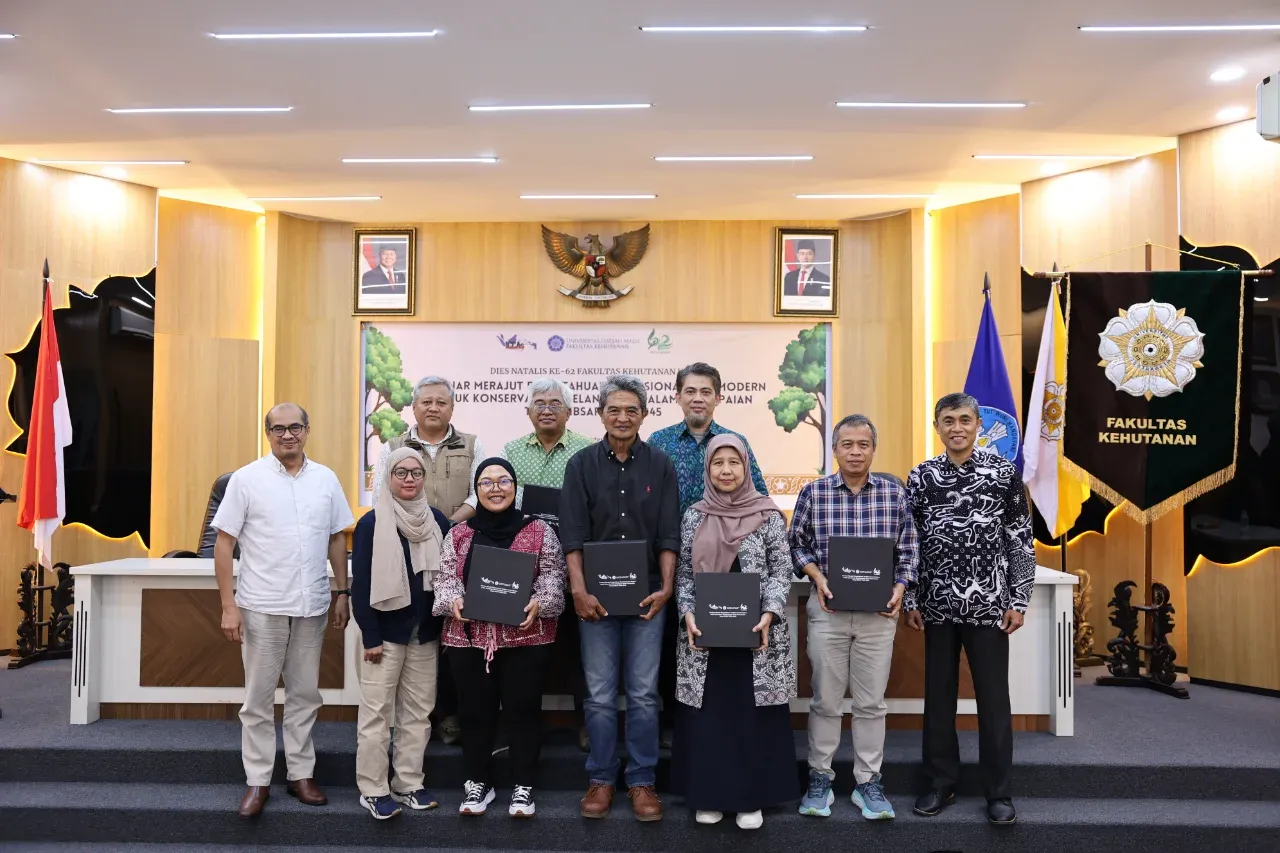
Through the Seminar Weaving Traditional and Modern Knowledge for Sustainable Conservation in Achieving IBSAP 2025–2024 Targets on Thursday, September 11, 2025, WGII Executive Coordinator, Cindy Julianty, stated:
"To solve this extinction crisis, the conservation approach needs to shift to be more inclusive and rights-based by involving everyone."
Cindy emphasized the need for encouragement in documenting, preserving, and developing conservation practices based on traditional knowledge to be utilized as learning resources or academic references.
Indonesia's commitment to conservation efforts is reflected in various international instruments, including the Kunming-Montreal Global Biodiversity Framework (KM-GBF) and the Convention on Biological Diversity (CBD). These instruments are then implemented nationally through the Indonesia Biodiversity Strategy and Action Plan (IBSAP) 2025–2045.
The Director of Biodiversity Conservation, Ministry of Environment, Ir. Inge Retnowati, M.E., explained that although the first target of KM-GBF is similar to IBSAP—30 by 30, protecting 30% of the earth's land and sea by 2030—the approach must be adjusted to national conditions. The focus is not only on achieving numbers but also on identifying areas of significant value for biodiversity and community life.
"In IBSAP, there are three main tasks: reducing threats, sustainable utilization, and developing governance of areas that should be protected due to their significant value for biodiversity. Whether it's forest conservation, marine conservation, fisheries, and others, and areas outside conservation areas are also of significant value for biodiversity. So, how do we have those areas and protect them, reduce their threats," said Mrs. Inge, her familiar address.
The perspective of indigenous peoples shows how conservation based on local values is more contextual and enduring. Putu Ardana, Indigenous People of Dalem Tamblingan, Catur Desa Bali, stated that like in maintaining Alas Mertajati and Lake Tamblingan, indigenous peoples have the most suitable conservation methods for their landscapes, based on hundreds of years of experience in sustaining life. Their relationship with nature forms a unity in a social system known as an eco-socio-system.
"The same thing we found with other indigenous peoples in Indonesia is that humans are part of nature, not rulers of nature. Some of our brothers even consider nature as part of their body. Some time ago, women from East Nusa Tenggara came to us. They refused to have their stones mined, saying it was not possible, those are our bones. Meanwhile, our brothers in Kalimantan, at the Utik River, consider the river their blood."
From the perspective of sociology-anthropology academics, the role of indigenous peoples has not received its rightful place in national planning documents. Lecturer in Sociology Anthropology Education at Sebelas Maret University, Dr.rer.nat. Nurhadi, S.Ant., M.Hum., highlighted the need for a broader and deeper understanding of traditional knowledge in planning documents like IBSAP 2025–2045, which he believes still marginalizes the role of indigenous peoples and focuses too much on material benefits.
"The incentives needed by traditional communities are not always about the material value they receive. They are already grateful just to be respected. Recognition and acknowledgment are very meaningful to them," he emphasized.
Ir. Dwiko Budi Permadi, S.Hut., M.Sc., Ph.D., IPU., as Vice Dean for Academic and Student Affairs at the Faculty of Forestry UGM, emphasized the importance of coproduction of knowledge—collaboration between scientific and local/traditional knowledge.
"In the context of IBSAP, this coproduction of knowledge means bridging science and policy, also strengthening the legitimacy of policies involving the knowledge owners. Then producing solutions that are more relevant and socially acceptable," he explained.
The seminar "Weaving Traditional and Modern Knowledge for Sustainable Conservation in Achieving IBSAP 2025–2045 Targets" has formulated several key thoughts, issues, potentials, and challenges. Some strategic recommendations produced include:
- Multi-stakeholder collaboration in the implementation of IBSAP 2025–2045.
- Integration of traditional and scientific knowledge through equal and participatory co-creation of knowledge.
- Documentation of local conservation practices as academic and policy references.
- Recognition and fair benefit-sharing for indigenous peoples and local communities.
- Rights-based conservation approach, through inclusive policy advocacy.
This formulation emphasizes that the success of achieving IBSAP requires active involvement of all stakeholders with meaningful participation and equal roles, integration of scientific and traditional knowledge, as well as support for equitable incentives and policies.
Through this collaborative dialogue, it is hoped that a shared awareness will be built that conservation is not only the responsibility of the state but also a collective movement of society, academics, businesses, and development partners. The seminar's formulation is expected to provide constructive input for policy formulation, capacity strengthening, and sustainable conservation practices relevant to Indonesia's social, cultural, and ecological context.
(***NafaZahra/AN)

Join Our Newsletter
Berlangganan buletin kami untuk mendapatkan pembaruan terbaru, berita, acara, dan aktivitas komunitas langsung ke kotak masuk Anda.
We respect you privacy, your email is safe with us.