Examining the Position and Recognition of Indigenous Peoples and Their Rights in the KSDAHE Bill
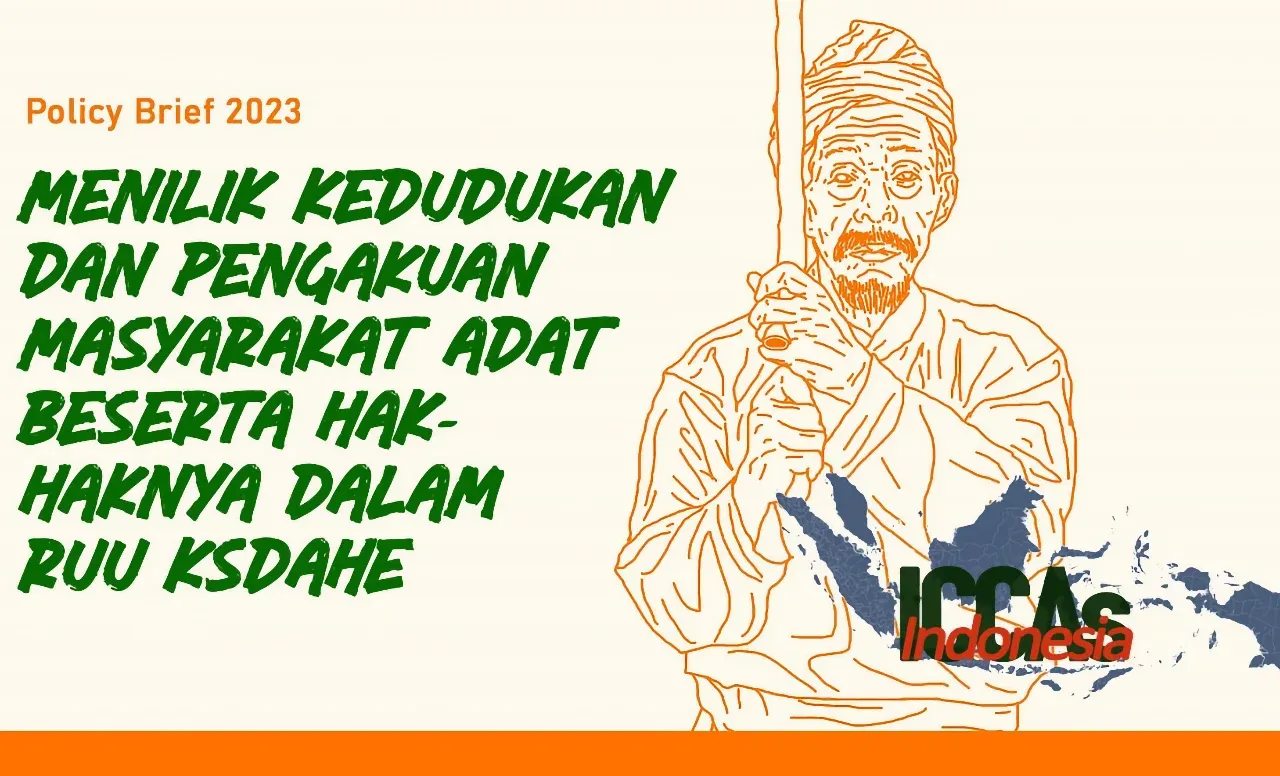
Towards the creation of inclusive, effective, fair, and sustainable conservation of biological natural resources and their ecosystems, WGII and its coalition launched the latest Policy Brief titled "Examining the Position and Recognition of Indigenous Peoples and Their Rights in the KSDAHE Bill". This Policy Brief is a thematic series of previous Policy Briefs to support the refinement of the Bill on Conservation of Biological Natural Resources and Their Ecosystems (KSDAHE Bill).
Specifically, this Policy Brief outlines the issues that policymakers need to consider regarding the position and recognition of indigenous peoples and their rights to participate in conservation management in Indonesia. This policy brief also emphasizes that the KSDAHE Bill needs to include discussions on the reorganization of conservation areas as a gateway to resolving tenure conflicts between indigenous peoples and the government in Conservation Areas.
The Indonesian House of Representatives (DPR RI) has proposed the KSDAHE Bill projected to replace Law No. 5 of 1990 with the same title. There are 4 (four) crucial issues that form the argument for changing the KSDAHE Bill, namely: First, the division of authority in the management of biological natural resources and their ecosystems. Second, community participation, including indigenous peoples around Conservation Areas. Third, funding in the management of KSDAHE. Fourth, the imposition of criminal sanctions in strengthening the authority of Civil Servant Investigators (PPNS).
The KSDAHE Bill is currently on the agenda of the National Legislation Program (PROLEGNAS). Discussions on amending Law No. 5 of 1990 have been ongoing since 2016, but to this day the KSDAHE Bill has not undergone a paradigmatic change, namely the imposition of a state conservation model. Although the KSDAHE Bill proposed by the DPR RI currently includes regulations regarding the existence of indigenous peoples in several articles and the recognition of Community Managed Conservation Areas (AKKM), the legal politics of the KSDAHE Bill still require recognition of the existence of indigenous peoples through Regional Regulations (Perda). This is certainly a burdensome requirement for indigenous peoples to gain recognition in conservation areas and hinders indigenous peoples from enjoying their constitutional rights. The KSDAHE Bill also has not fully illustrated meaningful participation in conservation management.
On the other hand, the term "conservation" itself has become a "bogeyman" for indigenous peoples. Unilateral claims by the state in establishing Conservation Areas without community consent have led to conflicts. The reorganization of Conservation Areas and conflict resolution should be one of the fundamental issues in the discussion of the KSDAHE Bill. Unfortunately, the substance of the KSDAHE Bill has not formulated this. Moreover, the KSDAHE Bill has not differentiated forms of prohibition for individuals and corporations that could lead to criminalization.
This Policy Brief provides several points of recommendation to policymakers to be reconstructed into the KSDAHE Bill regarding the rights of indigenous peoples, namely:
- Full and effective involvement of indigenous peoples is needed in the discussion of the KSDAHE Bill
- The KSDAHE Bill needs to change the form of the mechanism for recognizing the existence of indigenous peoples with Perda to a simpler and cheaper form of recognition but with legal legitimacy
- The KSDAHE Bill is the right momentum for resolving tenure conflicts between indigenous peoples and the government, starting with the reorganization of Conservation Areas
- The designation and management of indigenous territories as Conservation Areas must be carried out with FPIC principles
- Changing the approach to conservation management from a repressive to a more humanistic and collaborative approach between indigenous peoples and the government.
More details can be seen at:
Policy Brief March 2023: Examining the Position and Recognition of Indigenous Peoples and Their Rights in the KSDAHE Bill
Policy Brief February 2023: Seven Notes on Refining the KSDAHE Bill to Strengthen the Role and Participation of Communities in Conservation Management

Join Our Newsletter
Berlangganan buletin kami untuk mendapatkan pembaruan terbaru, berita, acara, dan aktivitas komunitas langsung ke kotak masuk Anda.
We respect you privacy, your email is safe with us.