The Necessity of Human Rights-Based Conservation: Notes on the KSDAHE Bill to Ensure the Fulfillment of Basic Community Rights in Conservation Implementation
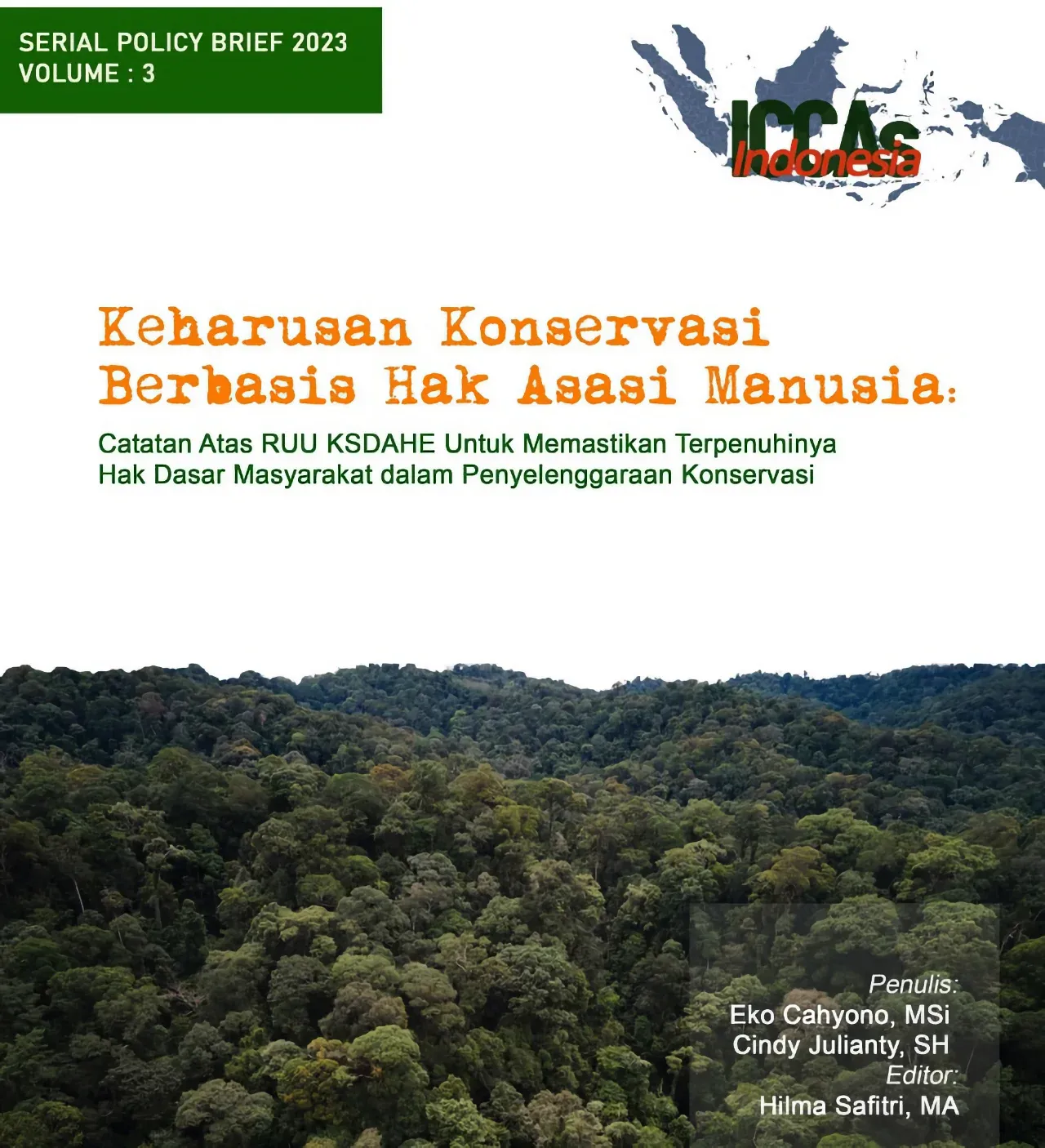
June 20, 2023, the Working Group ICCA Indonesia (WGII) launched the Policy brief series Vol. 3 titled The Necessity of Human Rights-Based Conservation: Notes on the KSDAHE Bill to Ensure the Fulfillment of Basic Community Rights in Conservation Implementation. This policy brief discusses various issues of conservation interpretation, the relationship between conservation and power, conservation policies and agendas. The important notes outlined in this policy brief serve as recommendations to policymakers for the improvement of the Draft Law on Conservation of Biological Natural Resources and Their Ecosystems (KSDAHE Bill) which is currently included in the National Legislation Program and is under discussion at Level 1.
Although the substance of the KSDAHE Bill proposed by the Indonesian House of Representatives shows positive changes compared to Law No. 5 of 1990, it is considered not strong enough to frame elements and dimensions of respect for human rights. As outlined in this policy brief, the definition of conservation itself still holds problems. The old conservation paradigm adopted in Law 5/90 is very much scientific forestry, focusing solely on "conservation for conservation's sake."
The global world through the Convention on Biological Diversity has shifted its conservation paradigm, as reflected in the latest Kunming – Montreal Framework, where to prevent and restore biodiversity loss, transformative efforts are needed through the involvement of indigenous peoples and local communities (IPLC) as conservation actors, a conservation approach that prioritizes human rights and inclusivity, and fair benefit sharing from conservation implementation. "Indonesia as a member of the CBD needs to incorporate this international agreement into supporting policy implementation," said Cindy Julianty, WGII Program Manager.
She emphasized, "The KSDAHE Bill projected to replace Law No. 5 of 1990, needs to redefine conservation to include socio-economic dimensions, human rights principles, and ecological sustainability simultaneously, and this new paradigm should become the 'soul' for all national Conservation Area policies and management."
The legacy of the scientific forestry paradigm that considers 'forests as human-free zones' also becomes the root of latent conflicts in Conservation Areas and criminalization. "Areas currently designated as Conservation Areas, both forests and coasts, are not empty spaces but territories of indigenous and local communities managed traditionally," explained Kasmita Widodo, WGII Coordinator. He added, "this is not just a territory but a living space for them where at least 4.1 million hectares of customary territories are designated as Conservation Areas and at least 16.3 million people live in 6,747 villages around Forest Areas including Conservation Areas."
"In many cases, the real threat to biodiversity conservation is business expansion, wildlife and plant trade syndicates and mafias, as well as developmentalistic conservation projects that ignore the human-nature relationship," said Cindy Julianty.
#AN
Other Policy Brief Series on the Draft Law on Conservation of Biological Natural Resources and Their Ecosystems:
Policy Brief March 2023: Examining the Position and Recognition of Indigenous Peoples and Their Rights in the KSDAHE Bill
Policy Brief February 2023: Seven Notes for Improving the KSDAHE Bill to Strengthen Community Roles and Participation in Conservation Implementation

Join Our Newsletter
Berlangganan buletin kami untuk mendapatkan pembaruan terbaru, berita, acara, dan aktivitas komunitas langsung ke kotak masuk Anda.
We respect you privacy, your email is safe with us.