Local Wisdom Recognized as Intangible Cultural Heritage and Its Guardians Protected by Ministry of Environment and Forestry Regulation No. 34 of 2017
[Jakarta, February 5, 2024] The Indigenous Territory Registration Agency (BRWA) in collaboration with the Working Group ICCAs Indonesia (WGII) and the Department of Anthropology, Faculty of Social and Political Sciences, University of Indonesia, held a Berandao webinar highlighting the theme "Exploring the implementation of recognition and protection of local wisdom in natural resource management and the promotion of cultural rights in Indonesia."
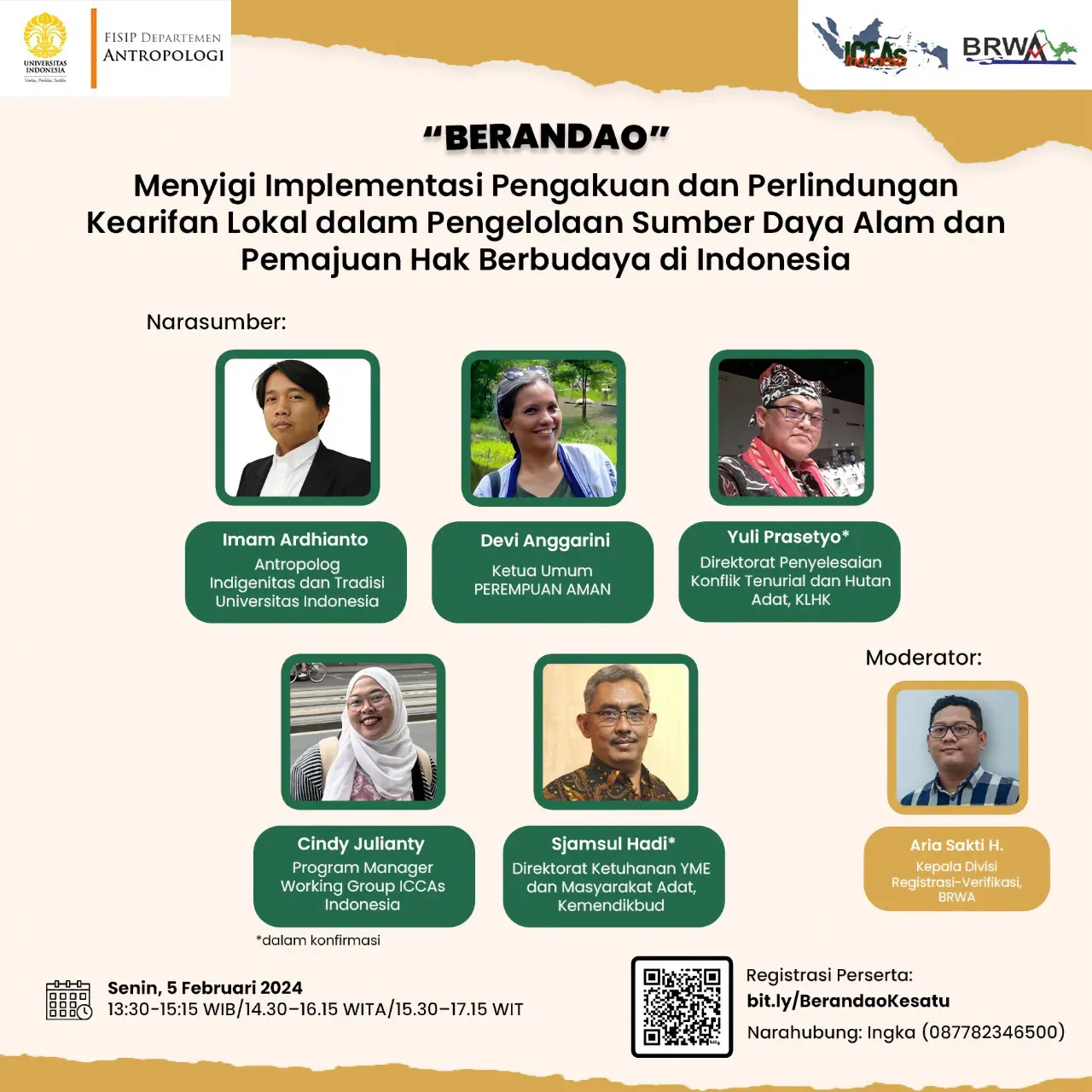
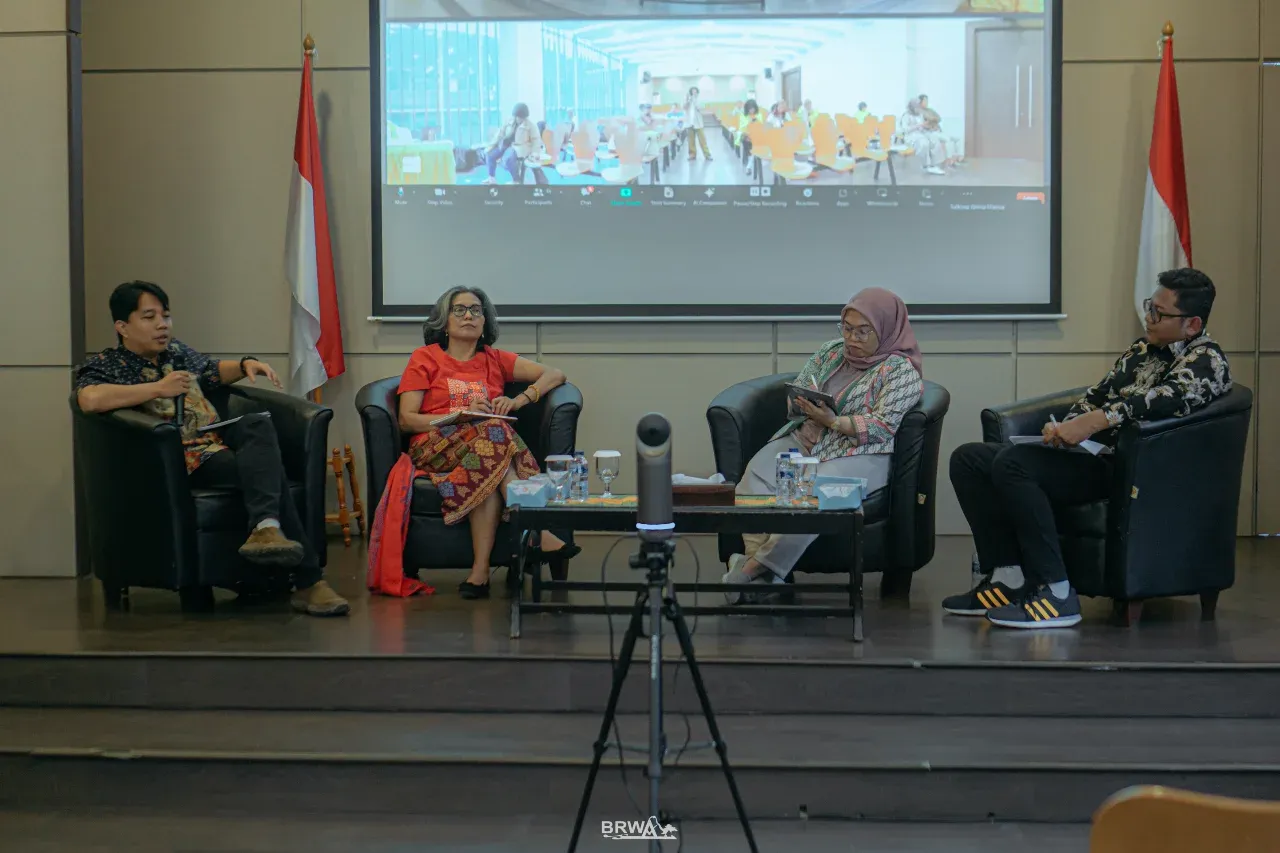
Image: Berandao Webinar: "Exploring the implementation of recognition and protection of local wisdom in natural resource management and the promotion of cultural rights in Indonesia." held at the Department of Anthropology, Faculty of Social and Political Sciences, University of Indonesia
Aria Sakti Handoko from BRWA, as the discussion moderator, opened the webinar by emphasizing that local wisdom is one of the elements forming Indonesia's identity as a cultured nation. Local wisdom is currently also seen as part of the solution in facing various environmental crises, both biodiversity crises and climate change. At least two Ministries have issued regulations on local wisdom, namely the Ministry of Environment and Forestry and the Ministry of Education, Culture, Research, and Technology.
Representing the Ministry of Education, Culture, Research, and Technology, Sjamsul Hadi, as the Director of Belief in the Almighty God and Indigenous Peoples, explained that in the context of culture, local wisdom is a domain regulated in the Ministry of Education and Culture Regulation No. 106 of 2013 concerning Intangible Cultural Heritage. This policy refers to the 2003 UNESCO convention on the safeguarding of intangible cultural heritage.
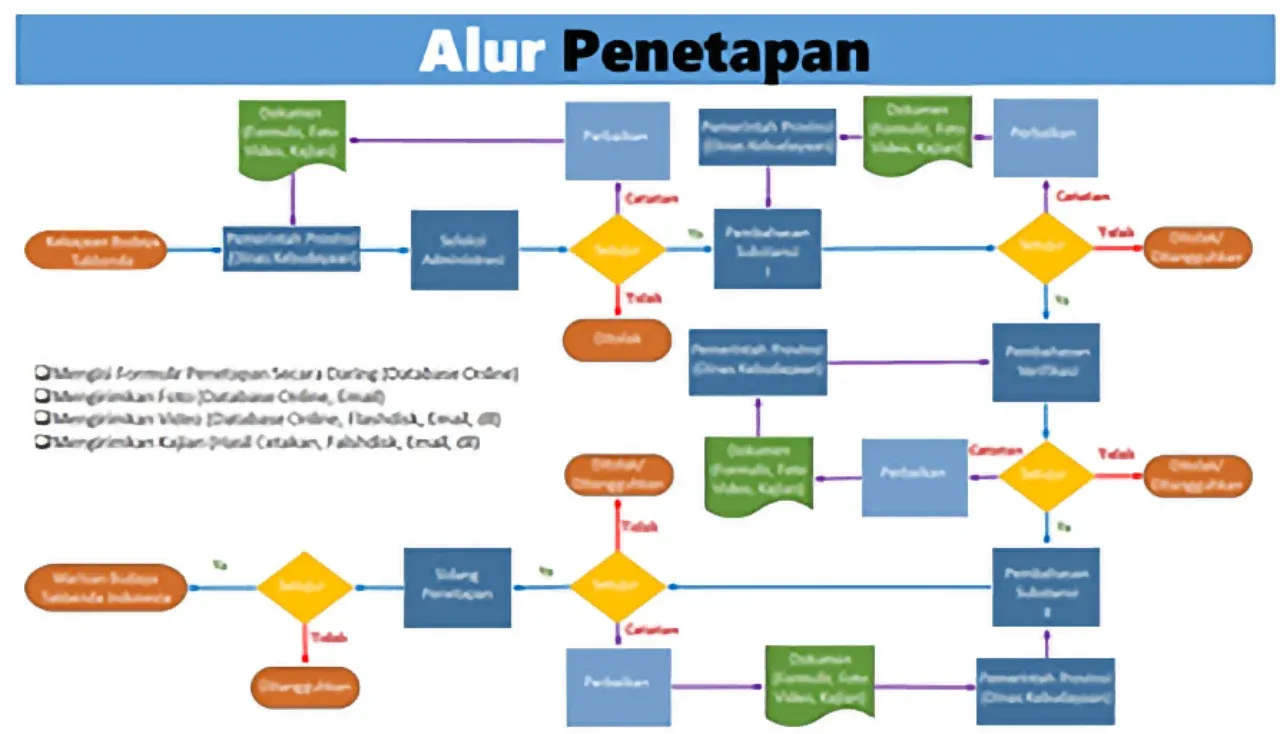
Sjamsul Hadi also explained that his directorate has several priority programs related to the documentation of local wisdom as Intangible Cultural Heritage, and almost every year the Ministry of Education, Culture, Research, and Technology has designated Intangible Cultural Heritage, which can be seen on the page https://warisanbudaya.kemdikbud.go.id/
"One of them is the Wana Budaya program at 29 indigenous forest points in Jambi, where we, together with the Ministry of Environment and Forestry, encourage the sustainability of local wisdom practices in the management of designated indigenous forests. Together with the community, we identify the potential of biodiversity wealth and its management by the community. This helps the community in drafting a clear roadmap post-designation of indigenous forests." He added, "we also build cooperation with Mrs. Devi (PEREMPUAN AMAN) to encourage the potential of indigenous women as the forefront in maintaining the inheritance system."
Yuli Prasetyo from the Directorate of PKTHA-PSKL Ministry of Environment and Forestry sees that the indigenous forests in Jambi are well managed by the community, perhaps even better than forests managed by companies, "Of course, the spirit of protection is because there is local wisdom. So, there are things they want to preserve related to genetic resources, water resources, and others." "The process of community adaptation with nature certainly gives birth to local wisdom, local knowledge, traditional technology, etc. That is what we (Ministry of Environment and Forestry) regulate in Regulation 34," explained Yuli Prasetyo.
He explained that the purpose and objective of the Minister of Environment and Forestry Regulation No. 34 of 2017 concerning Recognition and Protection of Local Wisdom in Natural Resource and Environmental Management is legal protection for the guardians and accessors of local wisdom. Also, a guarantee of fair profit-sharing for guardians over the utilization of their local wisdom by others.
"Accessors are external parties who utilize traditional knowledge managed by indigenous peoples or local communities. So (it is regulated) how the benefit-sharing is, especially later related to the pharmaceutical, culinary industries, etc., where indigenous peoples have always been left behind (not benefiting)." Traditional Knowledge is also regulated through the Government Regulation of the Republic of Indonesia No. 56 of 2022 concerning Communal Intellectual Property.
Documentation of Local Wisdom as Intangible Cultural Heritage Not Gender-Specific
Present at the webinar was Devi Anggraini, Chairperson of PEREMPUAN AMAN, providing an overview that women are subjects of preserving local wisdom and traditional knowledge, but the challenge is that their existence is often overlooked.
"Although there is documentation, it is not specifically gender-segregated. There is no gender-segregated data on how many women still practice traditional knowledge, what kind of traditional knowledge, and so on," responded Devi Anggraini.
"When talking about valuation, for example, the discussion is about the success of how many products (herbal medicine made by the community) are exported. The subject (indigenous women producing the herbal medicine) then disappears, indigenous women never appear. Therefore, PEREMPUAN AMAN works hard to bring out the presence and voices of indigenous women in these processes," Devi Anggraeni mentioned this as one of the challenges for indigenous women.
Policies Related to Local Wisdom Not Connected with Tenurial Guarantees
Cindy Julianty, Program Manager from the Working Group ICCAs Indonesia, highlighted the national policy that is very sectoral where matters concerning local wisdom are not automatically connected with tenurial matters, "There is a Ministry of Environment and Forestry Regulation on local wisdom, then a Ministry of Environment and Forestry Regulation on communal wealth, then other (policy) instruments on Intangible Cultural Heritage, all these policies do not solve tenurial issues. If only access to local wisdom is managed, but the security of the area is not managed, then it is the same. And as we know, the recognition of indigenous peoples in Indonesia has its own policy and the procedure is very complicated."
#AN
Editor's Note:
The Berandao webinar was initiated by BRWA together with WGII, functioning as a platform for dialogue and discussion on issues surrounding indigenous peoples and local communities and the various problems surrounding them. The term Berandao is inspired by the Dayak Iban indigenous people. In their culture, Berandao is an indigenous deliberation to discuss, make decisions, and uphold indigenous justice through local traditions and customs.

Join Our Newsletter
Berlangganan buletin kami untuk mendapatkan pembaruan terbaru, berita, acara, dan aktivitas komunitas langsung ke kotak masuk Anda.
We respect you privacy, your email is safe with us.