Minimal Participation and Transparency: The Advocacy Team for Equitable Conservation Presents Indigenous Community Witnesses and Parliamentary Monitors at the Formal Review Hearing of the KSDAHE Law
On May 2, 2025, the Constitutional Court of the Republic of Indonesia held a follow-up hearing on Case Number 132/PUU-XXII/2024 regarding the formal review of Law Number 32 of 2024 concerning Amendments to Law Number 5 of 1990 on the Conservation of Biological Natural Resources and Their Ecosystems (KSDAHE Law). The formal review request of the KSDAHE Law was submitted by the Indigenous Peoples Alliance of the Archipelago (AMAN), the Indonesian Forum for the Environment (WALHI), the People's Coalition for Fisheries Justice (KIARA), and representatives of the Ngkiong Indigenous Community in Manggarai NTT, Mikael Ane.
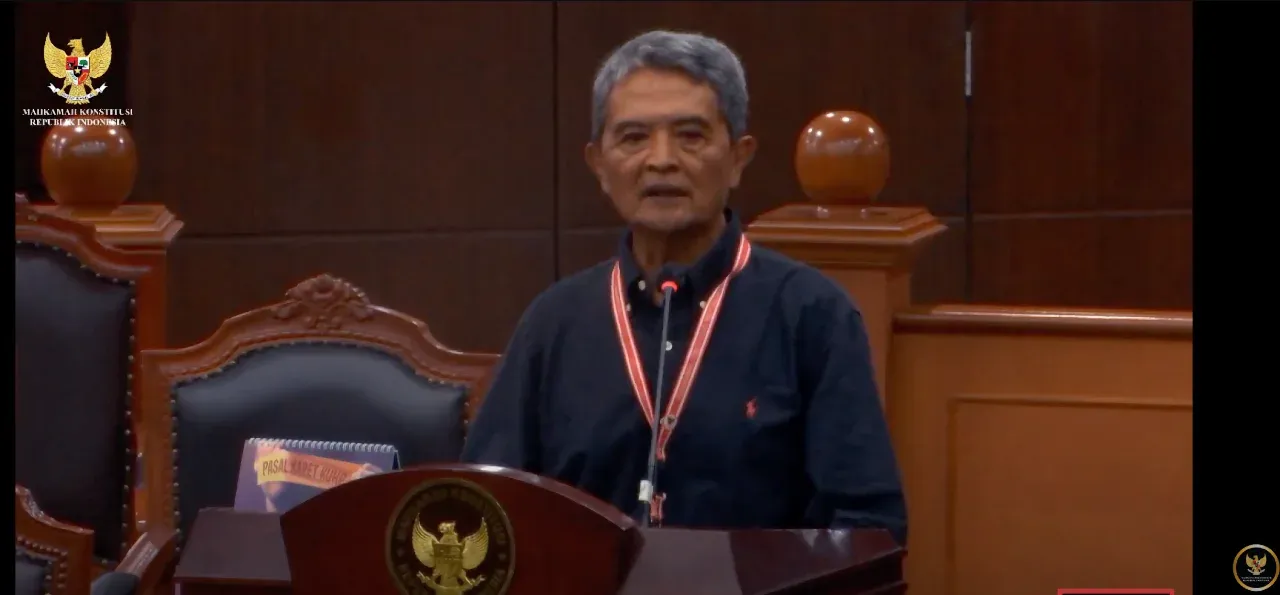
In the hearing, the Advocacy Team for Equitable Conservation, as the legal representative of the petitioners, presented two witnesses, namely Putu Ardana, a representative of the Dalem Tamblingan Indigenous Community, Bali, and Arif Adiputro from the Indonesian Parliamentary Center (IPC).
Indigenous Communities Involved Symbolically
Putu Ardana expressed his disappointment with the participation process conducted by the Indonesian House of Representatives (DPR RI). He attended as a resource person in the Public Hearing Meeting (RDPU) organized by Commission IV of the DPR RI on April 10, 2023. However, his involvement turned out to be merely symbolic—just fulfilling the formality of public participation, without any indication that his input was substantively considered in the drafting of the KSDAHE Law.
"I was shocked and proud at the same time because, as a villager, I was involved in participating in state affairs. So I was very enthusiastic to attend the Public Hearing Meeting (RDPU) and had very high hopes because I believe many of the conservation practices and management carried out by the state are very inappropriate and not suitable to be implemented in Indonesia," said Putu Ardana.
However, that pride quickly turned into disappointment when the process did not reflect a commitment to truly listen to the aspirations of indigenous communities.
"I was invited by Commission IV of the DPR, but only four commission members attended. The few DPR members present did not respond. As a resource person, I was only given 10 minutes, and it is very regrettable that after the invitation, I never received any updates on the progress. Suddenly, this law was already enacted," he continued.
Furthermore, Putu Ardana expressed his disappointment because his views presented during the RDPU with Commission IV of the DPR RI on April 10, 2023, were not accommodated in the KSDAHE Law.
Lack of Transparency, Flawed Participation
Putu Ardana's testimony was reinforced by the statement of Arif Adiputro from the Indonesian Parliamentary Center (IPC), who presented IPC's monitoring results on the lack of transparency in the entire legislative process of the KSDAHE Law—from the drafting of the academic text to its enactment.
Arif specifically highlighted the poor openness of information on discussion documents and meeting minutes and the failure to fulfill the principle of accountability in the law-making process.
IPC noted that during the drafting of the academic text, neither the draft academic text nor public input on the draft was ever openly published, either through the official DPR website or the DPR YouTube channel.
"On the DPR website, only the academic text document appears," explained Arif while presenting his findings.
Furthermore, IPC identified that out of 18 academic text drafting meetings, only one brief report document was published. Meeting notes and minutes, which should be open according to DPR Regulation No. 1 of 2020, were not available at all on the official DPR channels.
Moreover, Arif also explained that IPC had submitted public information requests to the DPR—including brief report documents, meeting minutes, attendance lists, the List of Issues Inventory (DIM), and the Panja Team documents. However, all these efforts were fruitless; either responded with inaccessible information or outright rejected without adequate explanation.
"We received a memo from the DPR containing a link, but the link could not be accessed. The request for the Panja Team documents was also rejected," he explained.
The Court Requests the Government to Submit Documents
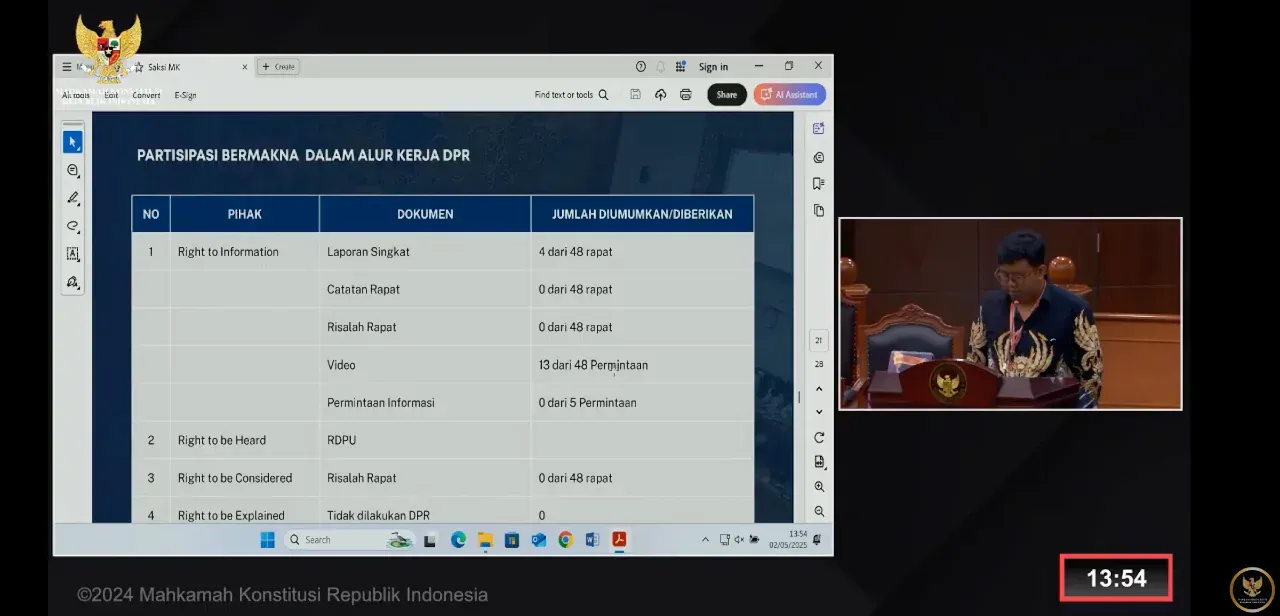
IPC emphasized that the legislative process of the KSDAHE Law failed to meet four aspects of meaningful participation:
- Right to Information: only 4 out of 48 meetings had brief report documents, no meeting notes or minutes were published.
- Right to be Heard: civil society was given very limited speaking time at the RDPU.
- Right to be Considered: no meeting minutes were available to assess whether civil society input was considered or not.
- Right to be Explained: no feedback or explanation on public input.
"This is the space to see whether stakeholder input is considered or not," concluded Arif.
The Constitutional Court judges in this hearing ordered the government to submit all documents related to the discussion of the KSDAHE Law, including the attendance list of meeting participants, as part of the evidence in this case.
The next hearing is scheduled for Tuesday, May 6, 2025, with the agenda of hearing the statements of the Regional Representative Council (DPD), witnesses, and experts from the President's side.
The Court is Asked to Present the Indonesian House of Representatives
In the hearing, the Legal Counsel and Advocacy Team of the Coalition for Equitable Conservation emphasized the importance for the Constitutional Court to present and hear the statements of the DPD RI, considering the important role of the DPD in discussing draft laws concerning natural resources.
"So we also ask Your Honor to present the DPD. Because according to Article 278 of the MD3 Law, the DPD has the authority to submit DIM related to regional autonomy and also natural resources. Those are the two things, Your Honor. Thank you very much," said Muhammad Arman, Legal Counsel and Advocacy Team of the Coalition for Equitable Conservation.
Regarding the statements given by the DPR RI at the hearing on April 28, 2025, at the Constitutional Court, it was found in the hearing on May 2, 2025, that the statements made by the DPR and the President potentially violated several principles and legal regulations.
This is considered a form of public deception through the delivery of information that can be categorized as fabrication. This form of violation is also considered potentially reportable to the House of Representatives Honorary Court (MKD).
Jakarta, May 3, 2025
ADVOCACY TEAM FOR EQUITABLE CONSERVATION

Join Our Newsletter
Berlangganan buletin kami untuk mendapatkan pembaruan terbaru, berita, acara, dan aktivitas komunitas langsung ke kotak masuk Anda.
We respect you privacy, your email is safe with us.