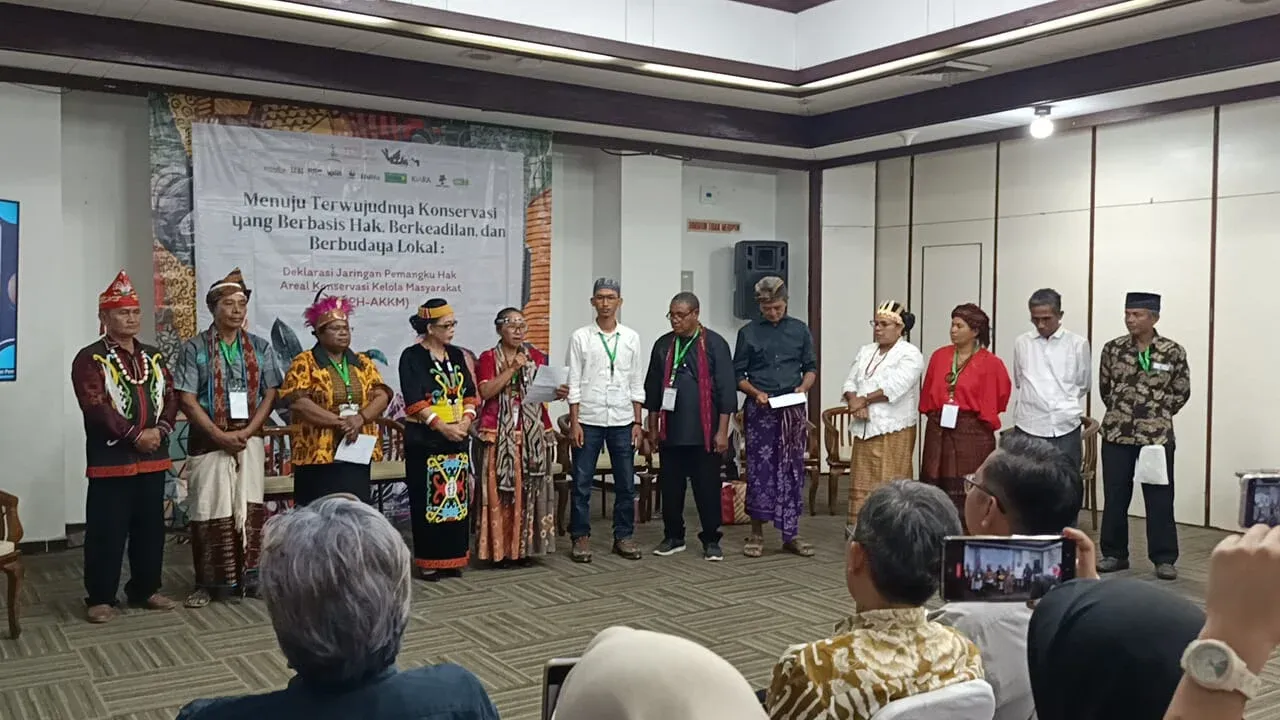
Network of Community-Managed Conservation Area Stakeholders (JPH AKKM) Declares Itself at the 2023 Tenure Conference Momentum
Tuesday, October 17, 2023, indigenous peoples and local communities that are part of the Network of Community-Managed Conservation Area Stakeholders (JPH AKKM) declared themselves at the side event of the 2023 Tenure Conference. Held at the Senayan Multipurpose Building, Naomi Marasian, Dolvina Damus, and Rukmini Toheke representing JPH AKKM emphasized that the government must recognize the conservation practices carried out by the community, because "the community is the main actor of conservation," asserted the three indigenous women.
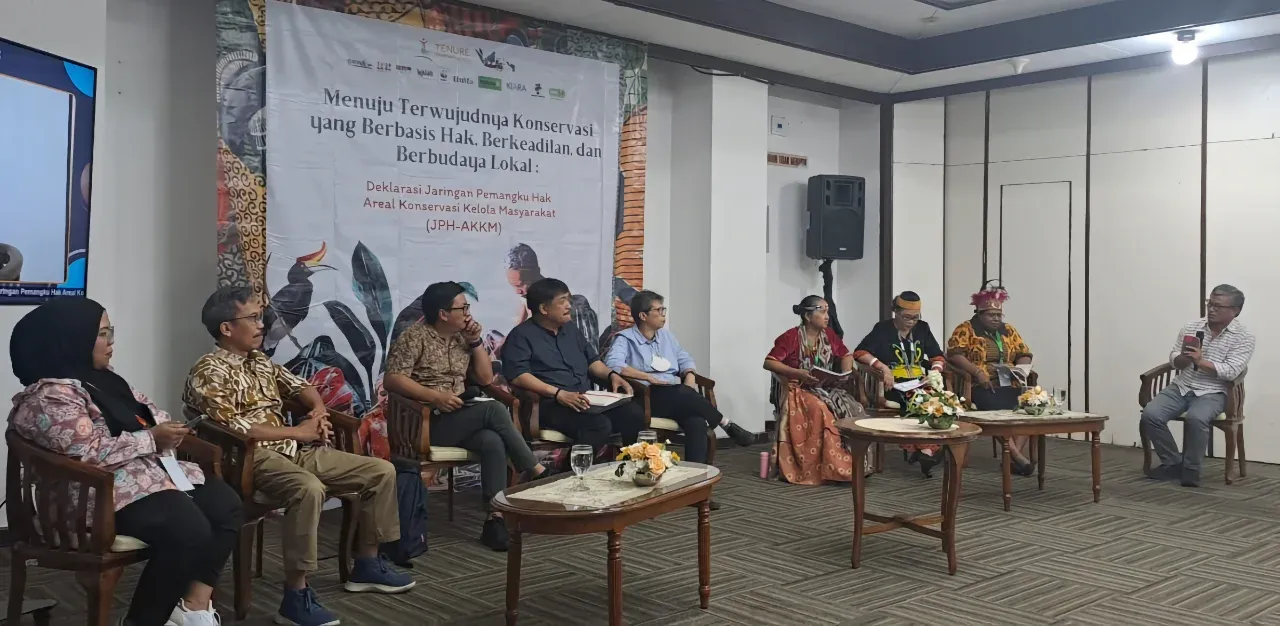
Side event of the 2023 Tenure Conference: Talkshow Towards the Realization of Rights-Based, Fair, and Culturally Local Conservation (10/17/23)
JPH AKKM are the rights-holders of areas preserved through local wisdom values. The rights-holders share the idea of forming a platform capable of responding to conservation approaches and management issues that are not rooted in culture and often neglect community rights.
Kasmita Widodo, Coordinator of WGII, stated, "the government has designated 27.4 million hectares of forest areas as conservation areas, but these are not empty spaces. Some of these conservation areas are living spaces for indigenous peoples and local communities with inseparable history, culture, and human-nature relationships." He stated, "the government still doubts that indigenous peoples can maintain ecosystems and biodiversity in Indonesia, so to address this doubt, documentation of community conservation practices is needed."
Rukmini Toheke, an indigenous person from Ngata Toro in Central Sulawesi, explained that their ancestors have passed down wise and fair management for all beings, "since long ago, ancestors advised that wana ngkiki should not be managed by anyone, because we know it is a source of water and a habitat for various animals, then there is wana, which is a jungle forest where only rattan, honey, and rompi (natural perfume from non-timber materials) can be taken."
Dolvina Damus, an indigenous Dayak Lundayeh Mentarang person in North Kalimantan, added "do you not trust us? the forest is home to the Dayak indigenous community. We would not destroy our own home (red-territory). Without us, there would not be the Kayan Mentrang National Park, which spans 1.3 million hectares."
Cindy Julianty, WGII program manager, stated "the natural resource management of indigenous peoples and local communities based on culture has proven far more effective than conservation introduced by the state. It is estimated that 54% of Indonesia's total area is indigenous territory, where 70% of the land cover in indigenous territories is forest in good condition," she added "joint analysis by BRWA, WGII, and FWI shows that 72% of indigenous territories are important ecosystems that are currently maintained and protected by indigenous peoples."
Over the past decade, the Working Group ICCAs Indonesia together with Indigenous Peoples and Local Communities have identified the potential of AKKM with an area of more than 4.2 million hectares, with a registration figure reaching 492,222 hectares into the iccas.or.id platform. This achievement is still very small compared to the existing AKKM potential, considering the registration figure of indigenous territories in BRWA has reached 26.9 million hectares.
#AN
Heri Yogaswara from the National Research and Innovation Agency, who was present as a respondent, emphasized "the study on AKKM practices must be included in the proposed indigenous forest documents. This will strengthen the recognition of indigenous peoples and their indigenous forests."
In their declaration, JPH AKKM conveyed the main points of their declaration:
Indigenous peoples and local communities are the main subjects in the management of conservation areas in Indonesia. Therefore, the government is obliged to fully and effectively involve indigenous peoples and local communities in the formation and management of conservation areas in Indonesia.
Community-Managed Conservation Areas (AKKM) that are protected and managed by indigenous peoples and local communities are an important part of inclusive and fair land and water conservation area management. AKKM is a conservation practice based on culture and traditional knowledge that has been proven, and therefore the government is obliged to fulfill the protection and recognition of the rights of indigenous peoples and local communities.
The formulation of natural resource conservation policies that are in process or in the future needs to change the conservation model and paradigm centered on the state to one based on human rights, namely respecting and appreciating the rights of indigenous and local communities in maintaining and protecting forests, coasts, seas, and other natural resources.
Inviting AKKM Rights-Holders spread across Indonesia to join and strengthen this JPH-AKKM, and to continue to protect conservation areas and living spaces for current and future generations.

Join Our Newsletter
Berlangganan buletin kami untuk mendapatkan pembaruan terbaru, berita, acara, dan aktivitas komunitas langsung ke kotak masuk Anda.
We respect you privacy, your email is safe with us.