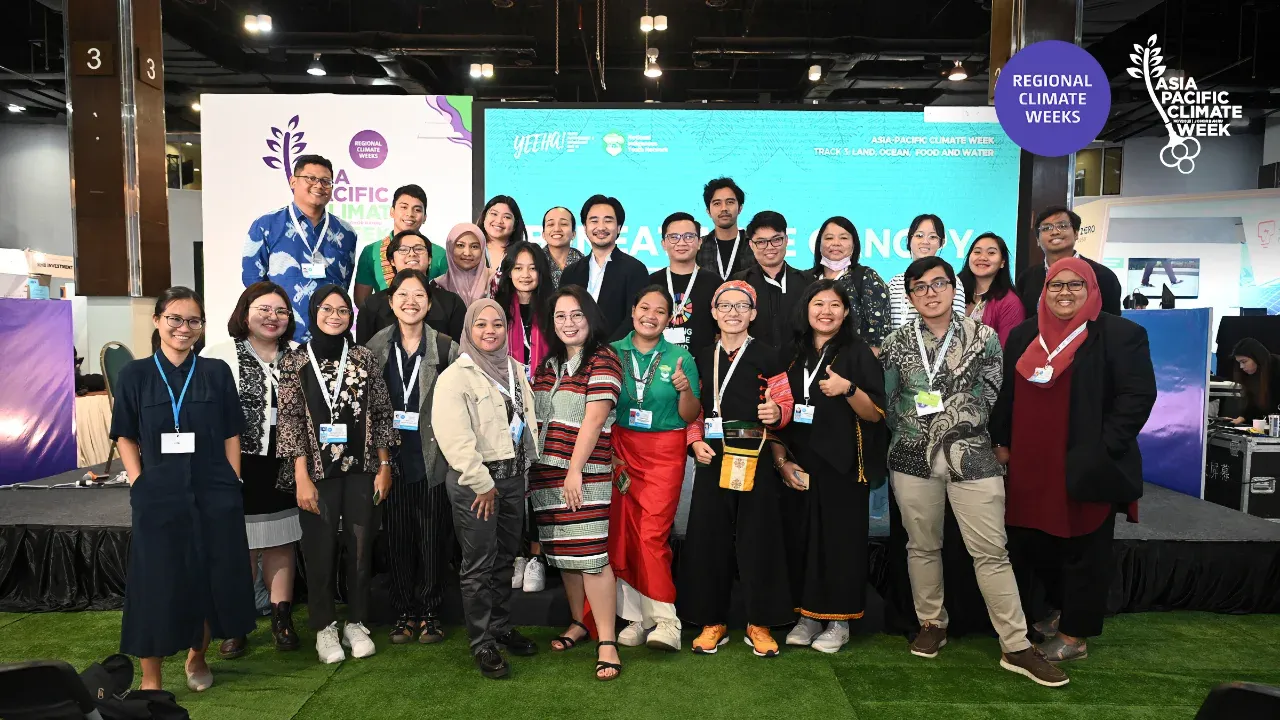
Indigenous Peoples Across Asia Pacific Assert Being Key Partners in Climate Action at Asia Pacific Climate Week 2023
Johor (November 16, 2023) Asia Pacific Climate Week takes place over 5 days from November 13 to 17, 2023, organized by the UNFCCC with the Johor state government as the host. This conference involves stakeholders, experts, and policymakers from all countries in the Asia Pacific to showcase solutions and innovations, as well as encourage increased cross-border and cross-sector cooperation in addressing urgent climate challenges.
Taking this opportunity, various parties focused on social justice and human rights issues, as well as indigenous peoples, reminded parties of their commitment to treat indigenous peoples as "key partners" in climate change dialogue, not just beneficiaries.
The International Indigenous Peoples Forum on Climate Change (IIPFCC), representing indigenous peoples at Asia Pacific Climate Week 2023 in Johor Bahru, Malaysia, stated that "all climate decisions and actions must consider the priorities and needs of indigenous peoples, with special emphasis on the experiences of indigenous women, youth, and children, persons with disabilities, and our gender-diverse relatives."
"The contribution of our traditional knowledge in adaptation, mitigation, and even in responding to Loss and Damage must be recognized and supported," added the organization.
Minnie Degawan, as one of the speakers at one of the APCW 2023 side events, explained that positioning indigenous peoples as key partners can be measured by how seriously the FPIC (Free, Prior, Informed, Consent) process is implemented.
"FPIC is an investment in a social process, so it cannot be done in a short time, let alone in a single visit. To make the right decisions, communities must gain comprehensive knowledge and understanding of climate change and carbon, so the FPIC process takes time," said Minnie.
Indigenous peoples and other marginalized groups are often sidelined in discussion and decision-making processes, even though they are the ones suffering and experiencing the direct impacts of current climate change, despite not being significant contributors to emissions.
Various global reports present empirical evidence that increasingly reinforces that indigenous peoples are at the forefront of protecting the remaining natural forests. According to the Right Resources Initiatives report (2022), indigenous peoples and local communities safeguard one-third of the remaining natural forests and protect 80% of the world's biodiversity. Yet, indigenous peoples worldwide only account for about 5-6% of the total global population. The ICCA Consortium report released in 2021 provides estimated data that 21% of the world's land is managed and conserved by indigenous peoples and local communities, referred to as Indigenous and Community Conserved Areas (ICCAs), and 22% of the potential ICCAs are Key Biodiversity Areas.
Voices of Indigenous Peoples, Women, and Youth
Maria Mono Soge (Shindy Soge), representing a grassroots youth organization from the Pangan Bijak coalition, shared her experience in building the WeTan HLR (Hewa Lewo Rotan) initiative as a youth response to climate change in the discussion session Official Session Track 4: Voices for Climate Action: Championing effective, inclusive, and equitable community-based solutions.
"We (youth) in the village strive for local food and conserve water sources," explained Shindy Soge. She noted that although indigenous peoples, farmers, and fishermen are at the forefront of climate change mitigation and adaptation actions, their involvement in forums discussing climate change is still minimal. This is related to limited access to opportunities, language barriers, and information gaps.
The International Indigenous Peoples Forum on Climate Change (IIPFCC) emphasized similar points to those expressed by Shindy Soge. According to the organization, indigenous peoples in Asia continue to face systemic weaknesses in advancing their advocacy at international conferences like APCW 2023.
The real experiences of communities on the ground in combating the tangible impacts of climate change should be the basis for policymakers to strengthen mitigation and adaptation actions. Asami Segundo, an indigenous woman from Ikalahan-Kalanguya, Philippines, emphasized, "listening to indigenous peoples in this forum (APCW 2023) is very important because whatever happens here will also impact those on the ground,"

Join Our Newsletter
Berlangganan buletin kami untuk mendapatkan pembaruan terbaru, berita, acara, dan aktivitas komunitas langsung ke kotak masuk Anda.
We respect you privacy, your email is safe with us.