No More Excuses! The State Must Acknowledge the Contribution of Indigenous Peoples and Local Communities in Biodiversity Conservation in Indonesia
Bogor, 06/04/2024, On May 22, 2024, we all commemorated World Biodiversity Day with the theme "Be Part of the Plan" which is a call to encourage the government, Indigenous Peoples and Local Communities, non-governmental organizations, lawmakers, businesses, and individuals to highlight their ways of supporting the implementation of the Biodiversity Plan. Everyone has a role to contribute to being #PartOfThePlan.
In this context, biodiversity policy and planning in Indonesia will currently be driven through the KSDAHE Bill (Conservation of Biological Natural Resources and Ecosystems) which is still in the legislative process in parliament, as well as the IBSAP document (Indonesia Biodiversity Strategy and Action Plan) which is currently still in the process of drafting and agreement at the Ministry and Agency level. IBSAP itself is a policy implementation that will continue the government's commitment to the Kunming Montreal Global Biodiversity Framework (KM-GBF) to prevent and address the biodiversity crisis until 2030.
In the last 2 (two) years since 2022, WGII has observed that the drafting process of the KSDAHE Bill and IBSAP has not maximally involved Indigenous Peoples, Local Communities, and the Public as important actors in policy consultation and drafting. Moreover, substantively, the latest draft of the KSDAHE Bill contains worse content than the initial draft proposed by the Indonesian House of Representatives. Civil Society Organizations on January 19, 2024, expressed their rejection of the KSDAHE Bill considering the substance that has the potential to increase the biodiversity crisis and human rights conflicts.
"The Conservation Practices we have carried out for thousands of years, such as the protection system in Tana Ulen, have not been recognized in the KSDAHE Bill, on the other hand, this Bill has the potential to weaken the situation in the Village and trigger new conflicts with Indigenous Peoples. We hope the government does not rush to pass the KSDAHE Bill if it is not yet in line with our proposals, especially if there are sanctions for relinquishing land rights in Preservation Areas, this is a big problem," said Dolvina Damus representing the Dayak Lundayeh Indigenous People.
Kasmita Widodo (WGII Coordinator) stated, "Law No.5/90 has marked a dark history of conservation area designation practices carried out with reckless processes and neglecting the FPIC process. One of the latent conflicts that occurred in Ruteng in 2004 was the overlapping conflict of customary territories with the Ruteng Nature Tourism Park which resulted in 6 deaths and 28 injuries and 3 people permanently disabled. Recently, this old conflict was repeated with the arrest of Customary Leader (Tua Teno) Ngkiong Mikael Ane in Ngkiong Dora Village, who was arrested and imprisoned for allegedly occupying the Ruteng Nature Tourism Park area. Even though Mikael Ane and his ancestors have been in and resided in the forest area before the Ruteng Nature Tourism Park existed and carried out activities. This case is just one of the many conflict cases in the designation of conservation areas that occur throughout the archipelago."
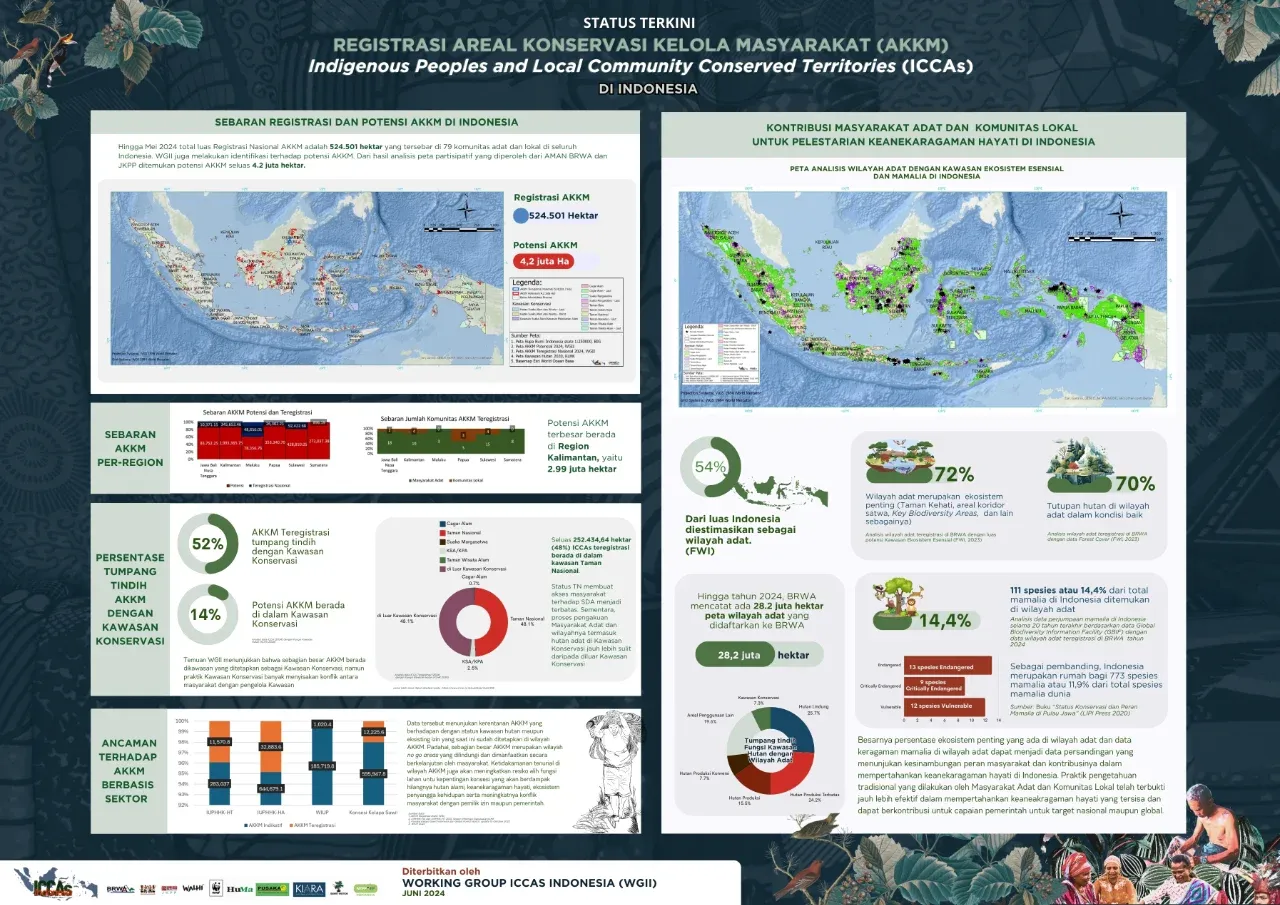
The KSDAHE Bill and IBSAP should be a hope to improve the biodiversity crisis, climate, and conflicts in conservation management. These policies should recognize the contributions of Indigenous Peoples and Local Communities who have protected biodiversity through their local wisdom as encouraged by the KM-GBF commitment. On June 1, 2024, WGII launched the latest data and recorded the AKKM (Indigenous Peoples' Managed Conservation Areas) Registration number in the WGII AKKM Registration system which has now reached 524,501 million hectares with AKKM potential reaching 4.2 million hectares. This data is only a small part of the good and effective practices carried out by Indigenous Peoples and Local Communities. When compared to the customary territory data registered with BRWA which has now reached almost 28 million hectares, the AKKM potential could be much larger.
Cindy Julianty, WGII Program Manager added, "The joint analysis results between BRWA, WGII, and FWI (Forest Watch Indonesia) show that 72% of important ecosystems (mangroves, karst, HCV wildlife corridor areas, and main biodiversity areas) are in customary territories. FWI studies show that 70% of land cover in customary territories is still in good condition, but in such conditions, 21.4% of customary territories also overlap with Limited Production Forest (HPT), placing customary territories with high biodiversity at risk of natural resource exploitation."
"We also found that there are at least 111 mammal species in customary territories or 14.4% of the total mammal species in Indonesia. Of this data, 13 species are Endangered, 9 species are Critical, and 12 species are Vulnerable. This data is an analysis of the distribution results of mammal species encounters in Indonesia over the past 20 years obtained from the Global Biodiversity Information Facility (GBIF) platform with participatory map data of customary territories. As a comparison, Indonesia is home to 773 mammal species or 11.9% of the world's total mammal species," continued Asti Noor (Knowledge Management Officer WGII).
Key Biodiversity Area and mammal data in customary territories can be comparative data showing the continuity of community roles and contributions in maintaining biodiversity. Therefore, there should be no more excuses for the government to underestimate the effectiveness of community-based conservation practices. The AKKM data aggregated by civil society is very feasible to be adopted and integrated to accelerate the recognition process of Indigenous Peoples' and Local Communities' rights and can be calculated and recognized in government reporting for national and global achievements.
Contact:
Lasti Fardilla Noor, Knowledge Management Officer WGII, Phone No. +62 813-8860-1039 and email: [email protected]
Related links:
Press Release "No More Excuses! The State Must Acknowledge the Contribution of Indigenous Peoples and Local Communities in Biodiversity Conservation in Indonesia"
Open letter on the Position and Stance of Civil Society on the Legislation of the KSDAHE Bill
Infographic on the Current Situation of Community Managed Conservation Areas (AKKM)
ICCA Indonesia Working Group (WGII)
Is a working group formed after the ICCAs Symposium in Bogor on October 13-14, 2011. WGII consists of 20 civil society organizations in Indonesia, including JKPP, AMAN, Sawit Watch, Pusaka, HuMa, KIARA, BRWA, Sawit Watch, NTFP-EP Indonesia, and WWF Indonesia. The WGII working group aims to promote and enhance understanding of managing and protecting natural resources and the environment by indigenous and local communities (ICCAs- Indigenous and Community Conserved areas) based on traditional knowledge and local wisdom, including supporting the realization of inclusive, fair conservation, recognizing and respecting the rights of indigenous and local communities. WGII became a member of the ICCA Consortium in 2015, and to this day is active in strengthening the ICCA Movement both at the global, Southeast Asian regional, and national levels.

Join Our Newsletter
Berlangganan buletin kami untuk mendapatkan pembaruan terbaru, berita, acara, dan aktivitas komunitas langsung ke kotak masuk Anda.
We respect you privacy, your email is safe with us.