Raising the Visibility of Indigenous and Community Conserved Areas (ICCAs) Through Documentation and Mapping
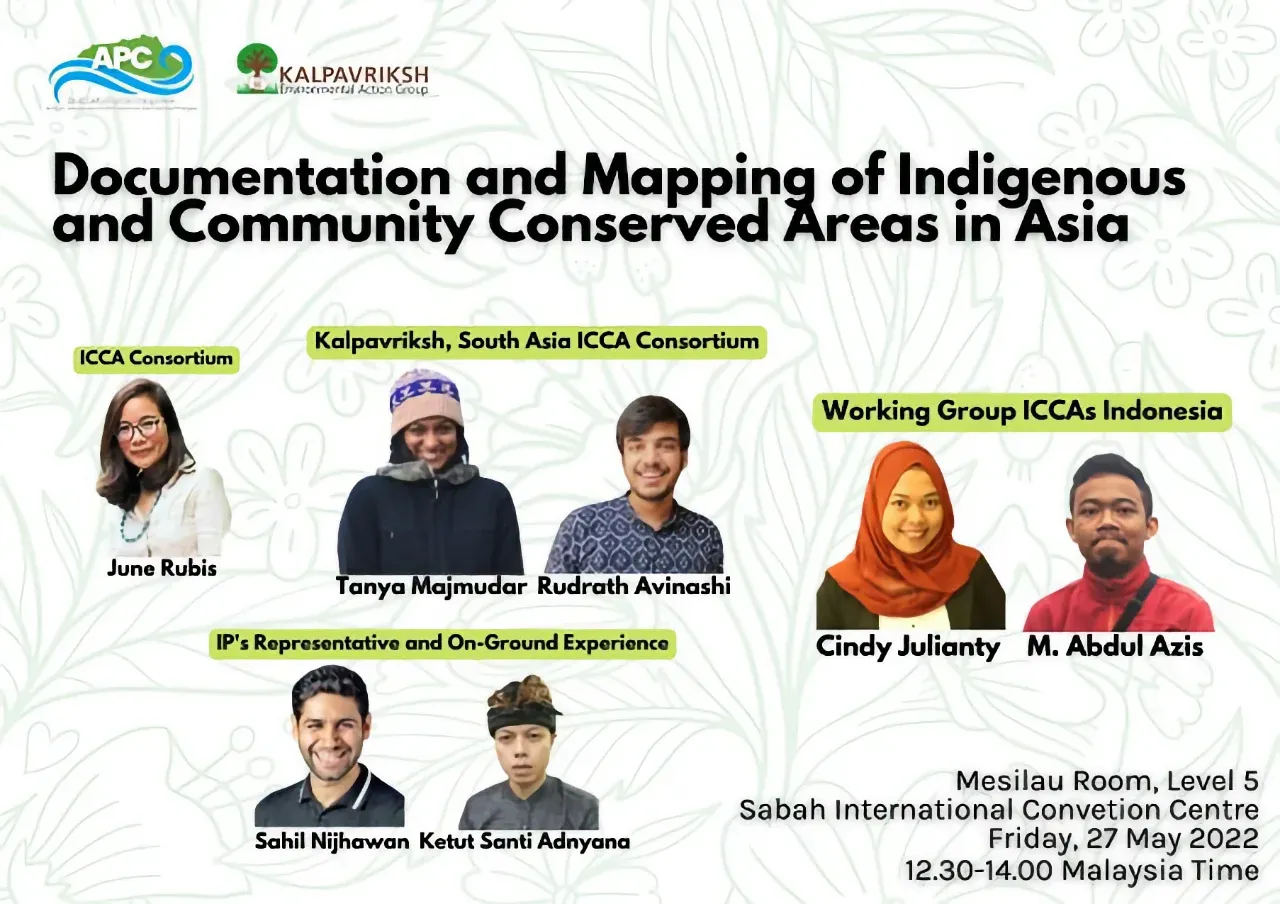
At the 2nd Asia Park Congress (APC) held at the Sabah International Convention Center from May 24-29, 2022, Kalpavriskh (India) and the Working Group ICCAs Indonesia (WGII) organized a side-event themed "Documentation and Mapping of Community Conserved Areas in Asia" on May 27, 2022. This side-event was a joint initiative to initiate a learning exchange activity between countries in Asia, particularly Indonesia and India, in advocating for the recognition and protection of ICCAs in their respective countries. This good opportunity was maximized to share experiences in mapping and documenting ICCAs, as one of the key issues voiced by the ICCA Consortium for the theme of documenting territories of life, which has been consolidated into a web-portal to more easily reach targeted audiences or parties supporting the protection of indigenous and local community rights.
This year's 2nd Asia Park Congress attempted to accommodate the presence and representation of indigenous and local communities to engage in inclusive and effective conservation management practices and models. This was well received by conservation organizations and individuals in Asia, considering how state conservation practices with the concept of Protected Areas have often excluded indigenous communities as landowners and important conservation actors. In reality, the strong connection of indigenous and local communities with their living territories, rooted in history, socio-cultural, customary law, spirituality, and wisdom practices, has given birth to various forms of territory and natural resource management with conservation values and spirit. Therefore, in the side-event organized by Kalpavriskh and WGII, representatives of indigenous communities were invited to directly voice the role of indigenous communities in managing indigenous territories that contain ICCAs, along with grassroots initiatives they have undertaken with their supporters.
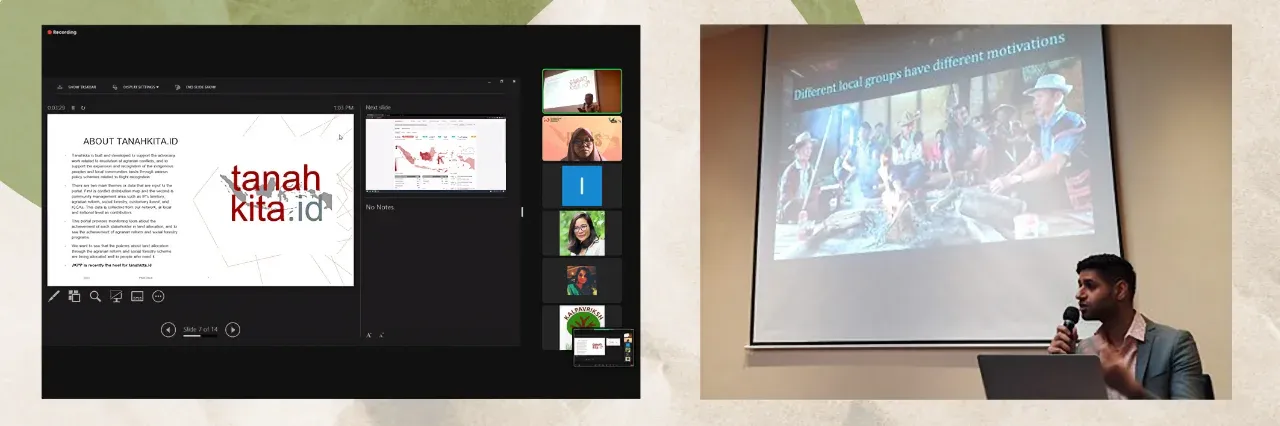
Rudrath Avinashi, a researcher and member of Kalpavriksh, in his presentation, explained that conventional conservation approaches have restricted access and usage rights of indigenous communities over their customary lands. "Since 1999 more than 13,000 families have been displaced from PAs (Protected Areas)," he explained. Systematic inequality then occurred due to the loss of livelihoods for millions of people, prohibition of access to seasonal grazing and resources, lack of access to apply traditional knowledge, and no certainty of rights to protect indigenous territories from extractive external threats. Poaching, timber theft, and destructive natural resource use in many conservation areas, a.k.a Protected Areas, eventually became unavoidable effects, raising issues of distrust among indigenous communities towards state conservation concepts.
This situation is complicated by the complexity of recognizing indigenous and local community rights through policy. A similar situation also occurs in Indonesia. Although the Constitution has recognized the existence of indigenous communities, their rights are not fully acknowledged. Policies on indigenous community rights are fragmented sectorally under different authorities, and none explicitly recognize conservation practices based on indigenous knowledge. "To this day, there is no policy that specifically recognizes indigenous community conservation practices. Opportunities are seen in the Draft Law on Biodiversity and Ecosystem Conservation, which mentions the term Indigenous Community Conservation Areas in its draft (2016). Unfortunately, this draft law has been removed from the national legislative program," explained Cindy Julianty, Program Manager of WGII.
Since its formation in 2011, the Working Group ICCAs Indonesia (WGII) has been working on documenting indigenous and local community conservation practices to realize the recognition and assurance of indigenous and local community rights by the government. Mapping and documentation initiatives are carried out based on the principles of self-identification and self-determination. This documentation records how conservation practices by indigenous and local communities are strongly attached to historical identity, customary law, customary institutions, social order, culture, way of life, local knowledge and wisdom, spirituality, and reciprocal relationships with nature and territories. Such knowledge and practices also directly contribute to environmental and natural resource conservation.
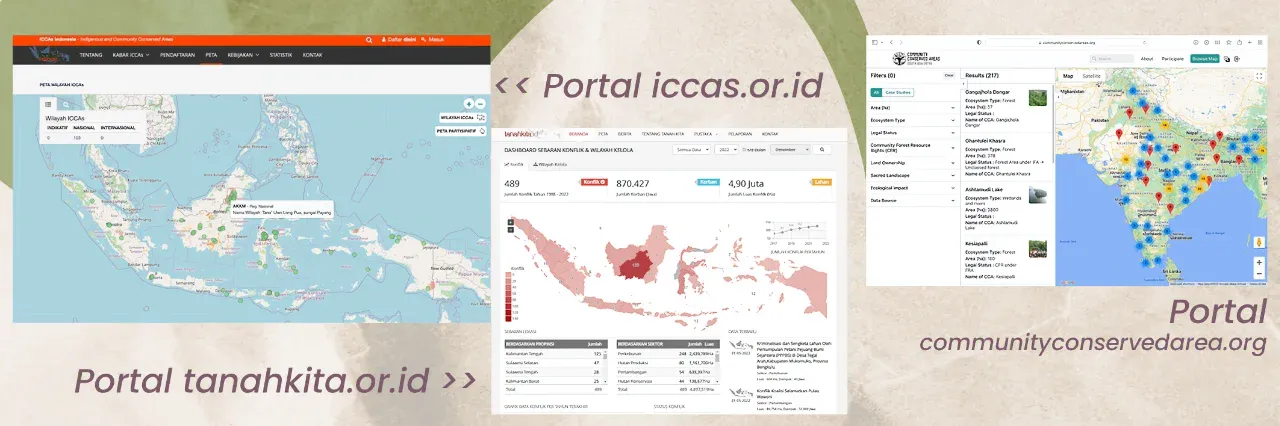
So far, 462,650.61 ha from 104 ICCA locations have been documented by WGII. This number will continue to grow, considering the potential of ICCAs in Indonesia reaches 2.9 million ha. Therefore, WGII created a webGIS-portal database that can consolidate this information so it can become a shared platform to support the struggle for indigenous and local community rights and promote ICCAs to the public.
The icca.or.id geoportal serves as a social and spatial database of the distribution and wealth of ICCA information in Indonesia, both through registration mechanisms, potential (indicative), and international registration. Together with the tanahkita.or.id geoportal, the tenurial situation of ICCAs is clearly presented, showing how overlaps and agrarian conflicts are problems faced by indigenous communities over their territories. On the other hand, tanahkita.or.id also presents and monitors the progress of recognition of indigenous and local community land rights through various available schemes through several policies, including Customary Forests, TORA, and Social Forestry.
A similar initiative is also built by Kalpavriksh. In India, ICCAs are not yet recognized by the government. This prompted Kalpavriksh, as the Coordinator of the South Asia ICCA Consortium, to build an ICCA database that presents maps and ecological information of conservation and cultural practices in India. This portal attempts to build ICCA visibility to the public and challenge conventional conservation models by presenting various research on the impact of policy changes and exclusive conservation.
At the end of the event, indigenous communities from Indonesia, represented by Ketut Santi Adnyana from the Dalem Tamblingan Indigenous Community, delivered a presentation on the community's experience in initiating processes of indigenous and customary forest recognition, starting from participatory mapping involving youth and women, biodiversity inventory, proposing customary forests, to promoting community empowerment by developing local products and learning centers. Ketut Santi Adnyana stated, "Embracing the Memories of Alas Mertajati is the theme I chose because the traditional system inherited by our ancestors holds many important values for us to uphold and preserve." Furthermore, he emphasized that "Documenting indigenous territories and ICCAs is an effort to digitize ancestral knowledge so that it becomes a provision for the Dalem Tambilangan Indigenous Community and youth in fighting for Alas Mertajati to gain recognition as Customary Forests."
In closing, Ketut Santi Adnyana, as an indigenous community member, hopes, "Hopefully this (documentation) is not only done by Indonesia and India but also the entire world, and we can all be connected. The government often forgets the significant role of indigenous communities in protecting their territories, so this documentation becomes a way to recognize and protect indigenous community rights." This is also the goal of holding the side-event at The 2nd APC 2022. Documentation and mapping initiatives, both by grassroots and non-governmental organizations like WGII and Kalpavriskh, can bring the existence of indigenous communities and their territories and local wisdom to a more visible level, both to the government and the public.
Authors: AN & CJ

Join Our Newsletter
Berlangganan buletin kami untuk mendapatkan pembaruan terbaru, berita, acara, dan aktivitas komunitas langsung ke kotak masuk Anda.
We respect you privacy, your email is safe with us.