Increase of five million hectares in registered customary territories in Indonesia: New BWRA data
Indonesia recently published the latest information on the recognition status of customary territories and customary forests.
In celebration of the 23rd Indigenous Peoples Awakening Day (March 17), the Ancestral Domain Registration Agency (Badan Registrasi Wilayah Adat- BRWA) released the latest data on "the recognition status of Customary Territories in Indonesia" sourced from the BRWA Customary Territory Registration System.
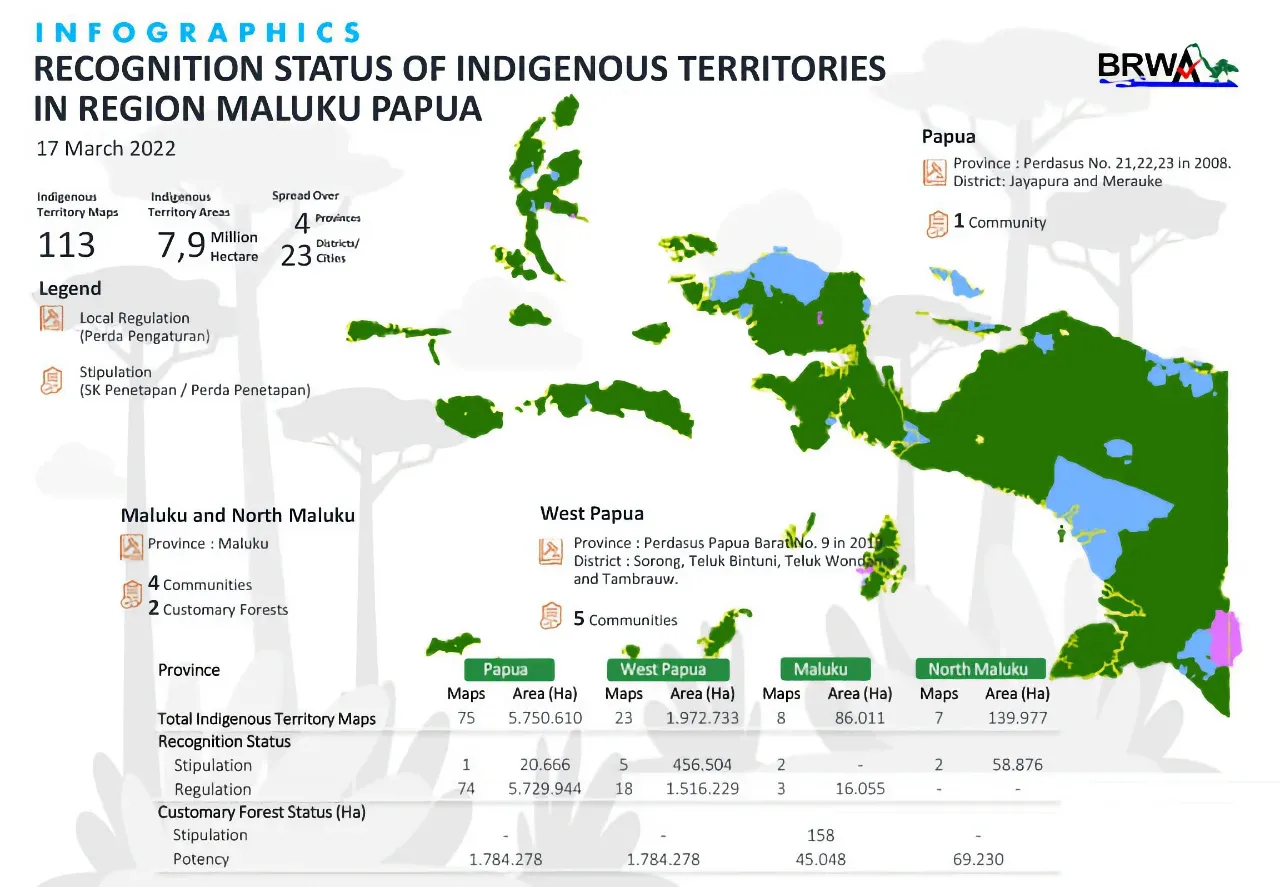
Over the six months up to February this year, the Customary Territory Map registered by BRWA increased by five million hectares, from 12.4 million hectares to 17.6 million hectares. This is a 41% increase since the previous data release.
This increase in the coverage of customary territories is mainly contributed by mapping conducted in the Papua region.
The BRWA Customary Territory Registration System records data and information regarding Indigenous Peoples and their customary territories. BRWA standardizes spatial data (maps) and social data (Profiles) of Indigenous Peoples through the registration, verification, and certification of customary territories.
To date, BRWA has registered 1,091 Customary Territory Maps covering approximately 17.6 million hectares spread across 29 provinces and 141 districts/cities.
In Indonesia, the recognition of Indigenous Peoples and their territories was first carried out through regional policies at the provincial and district/city levels. This is done by issuing Regional Regulations that can directly recognize Indigenous Peoples and their territories (provisions) or regulate the recognition procedures (regulations) — in this case, a Regent's Decree is usually required to complete the recognition process.
Of the 17.6 million hectares registered by BRWA, about 15.28% or 2.69 million hectares have been recognized by local authorities at the sub-national level, totaling 176 Customary Territories.
The remaining 12.79 million hectares covering 667 Customary Territories are in provinces that have issued Regional Regulations on the general recognition process—but still require local decisions for specific territory recognition. For the remaining 2.15 million hectares that have been mapped, there is no Decision/Regional Regulation for recognition yet.
At the national level, the recognition rate of customary forests by the Ministry of Environment and Forestry (KLHK) has also increased, although not significantly. So far, KLHK has issued 89 decisions recognizing customary forests covering 89,783 hectares. This is only about 0.65% of the current potential of 13.76 million hectares for customary forests recorded by BRWA.
On the other hand, these recognized customary forests are still far from the official indicative number of customary forests issued by the Ministry of Environment and Forestry, which is 1,152,600 hectares. Most of the indicative customary forests recorded by KLHK have met the requirements for customary territory recognition at the regional level, with the issuance of Regional Regulations or Regent's Decrees.
Therefore, KLHK needs to promptly conduct technical verification of the customary forests that have been submitted by Indigenous Peoples for recognition.
1 Regional policies that directly recognize the existence of Indigenous Peoples and their territories can be in the form of a Regent's Decree (SK decision) or a Regional Regulation (Perda decision). Such policies do not require further steps at the local level.
2 Regional policies that establish procedures for recognizing Indigenous Peoples and their territories require further steps, such as a Regent's Decree establishing an indigenous task force (SK Panitia MHA) responsible for processing Indigenous Peoples Recognition at the regional level, and a final decision to establish the existence of Indigenous Peoples and their territories.
Source: Badan Registrasi Wilayah Adat

Join Our Newsletter
Berlangganan buletin kami untuk mendapatkan pembaruan terbaru, berita, acara, dan aktivitas komunitas langsung ke kotak masuk Anda.
We respect you privacy, your email is safe with us.