Without a New Food Estate, Indonesia Has Already Exceeded Deforestation Quota
Baku, Azerbaijan, November 13, 2024 — The Food Estate or national food barn program is not the answer to Indonesia's food problems. This program has the potential to damage natural forest ecosystems that should be preserved.
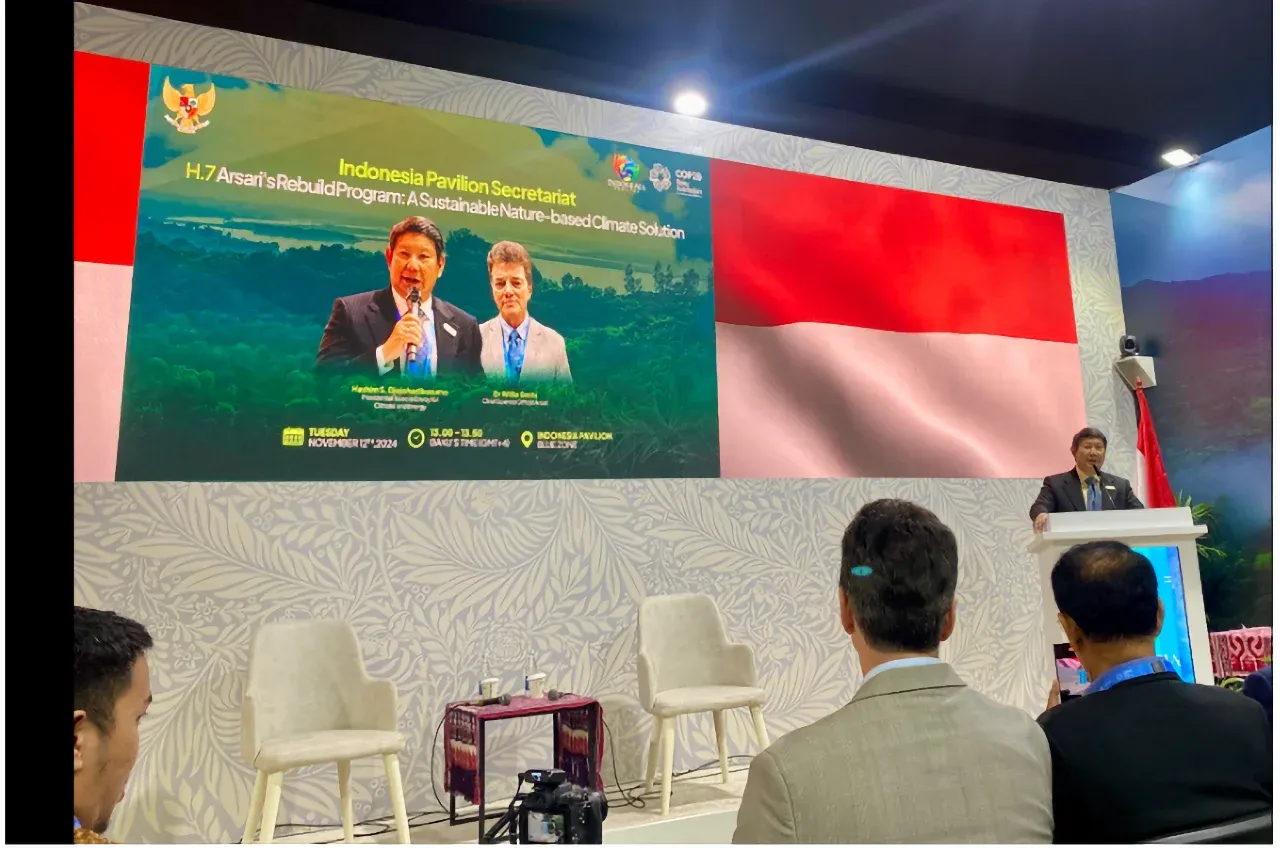
This statement responds to the speech of the Special Envoy of the Republic of Indonesia Delegation, Hashim Sujono Djojohadikusumo, at the COP29 plenary session (11/12/2024), which stated that the Food Estate program continues. Previously, President Prabowo had visited the Food Estate location in Merauke Regency, South Papua, which has been plotted to cover more than 2 million hectares as the focus of his government's Food Estate.
According to Nadia Hadad, Executive Director of the Madani Sustainable Foundation who also attended COP29 in Baku, Azerbaijan, the Food Estate as a National Strategic Project has the potential to become a red carpet for the exploitation of natural resources and forests. Meanwhile, Indonesia has a FOLU Net Sink 2030 commitment, with a target to reduce the deforestation rate by 4.22 million hectares by 2030.
Based on the Indonesian FOLU Net Sink 2030 Operational Plan document, Indonesia's deforestation up to 2019 has reached 4.8 million hectares. This means Indonesia's deforestation quota has been exceeded or is minus 577 thousand hectares. By opening a Food Estate, this further threatens Indonesia's climate commitment to the world.
"The process of ecosystem recovery through land restoration and rehabilitation takes a very long time and often cannot return ecosystems to their original conditions, such as peat and mangrove ecosystems," said Nadia in her press statement (11/13/2024).
Nadia explained that to achieve the NDC target, deforestation prevention must be prioritized by implementing the right policies. "Relying solely on restoration and rehabilitation will complicate Indonesia's climate commitment achievement. Prevent first, then restore," said Nadia.
In his speech, Hashim used the argument that a food security program is very necessary to maintain Indonesia's independence from external shocks that we have seen and experienced in recent years. President Prabowo's younger brother cited the COVID-19 Pandemic and the Ukraine-Russia War as causes of rising food and fertilizer prices some time ago.
Hashim mentioned that the international community misunderstood the food barn program, which is said to damage forests. "Indonesia will recreate, revitalize, rejuvenate degraded forests (due to the Food Estate program). This is already a program that will reduce any problems that may arise," he continued.
Cindy Julianty from the Working Group ICCAs Indonesia (WGII) considers the Food Estate program to have failed in addressing food security issues and has caused many conflicts. One of them is with indigenous peoples. "The empirical fact that is happening in Merauke now is that more than two million forests, which are part of the customary territories of the Malid, Maklew, Khimaima, and Yei communities, have been completely cleared for food estate purposes," she said.
Forests are a source of natural food for indigenous peoples and are even part of the development of biodiversity. Cindy also mentioned the need for the community to scrutinize the forest restoration target of 12.7 million hectares under the Prabowo Subianto Government.
"Does this number overlap with customary territories and people's management areas or not? Will it be done through a consultation and FPIC process, and will indigenous or local communities benefit from this restoration agenda?" she said.
The Importance of Joining the FCLP Partnership and Securing Climate Funding
Nadia questioned why Indonesia has not joined the FCLP (Forest and Climate Leaders' Partnership). FLCP is an initiative to halt and reverse forest loss by 2030. "Even though in the statements of heads and state officials in the panel, Indonesia is often mentioned as a champion in the FOLU Net Sink 2030 initiative," said Nadia.
Indonesia's joining the partnership, she added, can ensure the mobilization of funding from developed countries to developing countries and tropical forest owners to protect tropical forests so that global climate targets listed in the Paris Agreement can be achieved.
According to Eka Melisa from the Partnership, it is unfortunate that the special message from Hashim at the COP 29 plenary on November 12, 2024, did not highlight Indonesia's position as a country with quite high vulnerability to climate change, where increasing resilience and adaptability to climate change is very important.
Moreover, this is the COP Finance, it should be about how access and distribution of climate funding are targeted, including focusing on increasing the capacity of communities and national and local governments on the three important issues of climate resilience, which should be one of Indonesia's priorities.
"This should be a package, as we promote in the Enhanced NDC document as well: ecosystem and landscape resilience, community and social resilience, and economic resilience," said Eka.
Iqbal Damanik from Greenpeace sees that Indonesia is not leading and does not have a clear and strong target and message related to funding at COP29 Baku. "It is very unfortunate that at COP29 Baku, which is touted as a COP focused on funding, Indonesia has not seen the importance of playing a significant role in directing climate funding to be on target," he said.
Indonesia should be able to be a loudspeaker for countries vulnerable to the climate crisis. "Indonesia must take a role globally, to have the opportunity to secure larger climate funding, such as funding for mitigation, adaptation, and loss & damage actions," said Iqbal.*****
Press Release November 13, 2024, Without a New Food Estate, Indonesia Has Already Exceeded Deforestation Quota
Contacts:
1. Nadia Hadad - MADANI Sustainable | +62 811132081
2. Cindy Julianty, WGII (Working Group on Indigenous and Local Communities Conserved Areas and Territories Indonesia) | [email protected] | +62 851-2110-7321
3. Iqbal Damanik - Greenpeace Indonesia | +62 811-4445-026
4. Eka Melisa - Partnership for Governance Reform | +62 818-764-746
Official COP 29 photo archive https://cop29.az/en/media-hub/media-gallery
Special Envoy Hashim Sujono Djojohadikusumo at the Indonesia Pavilion delivering his remarks in the Sustainable Nature-based Climate Solution session
Editor's Note:
Working Group ICCAs Indonesia (WGII) is a working group formed after the ICCAs Symposium in Bogor on October 13-14, 2011. ICCAs Indonesia consists of several 10 National NGOs in Indonesia, including JKPP, WWF Indonesia, KIARA, NTFP-EP Indonesia, WALHI, AMAN, Sawit Watch, Pusaka, Huma, and BRWA. The WGII working group aims to promote and enhance the understanding of the practice of natural resource and environmental management by indigenous peoples and local communities (ICCAs - Indigenous and Community Conserved Areas) based on local wisdom or customs practiced by them. WGII has been a member of the ICCA Consortium since 2015 and is currently active in strengthening the ICCA movement at both the global and national levels to recognize the rights of indigenous peoples and communities over their territories, land, and ICCAs.
FOLU (Forest and Other Land Use) Net Sink is a condition where the level of carbon absorption by the forestry sector and other land uses is higher than the level of emissions produced in 2030.

Join Our Newsletter
Berlangganan buletin kami untuk mendapatkan pembaruan terbaru, berita, acara, dan aktivitas komunitas langsung ke kotak masuk Anda.
We respect you privacy, your email is safe with us.