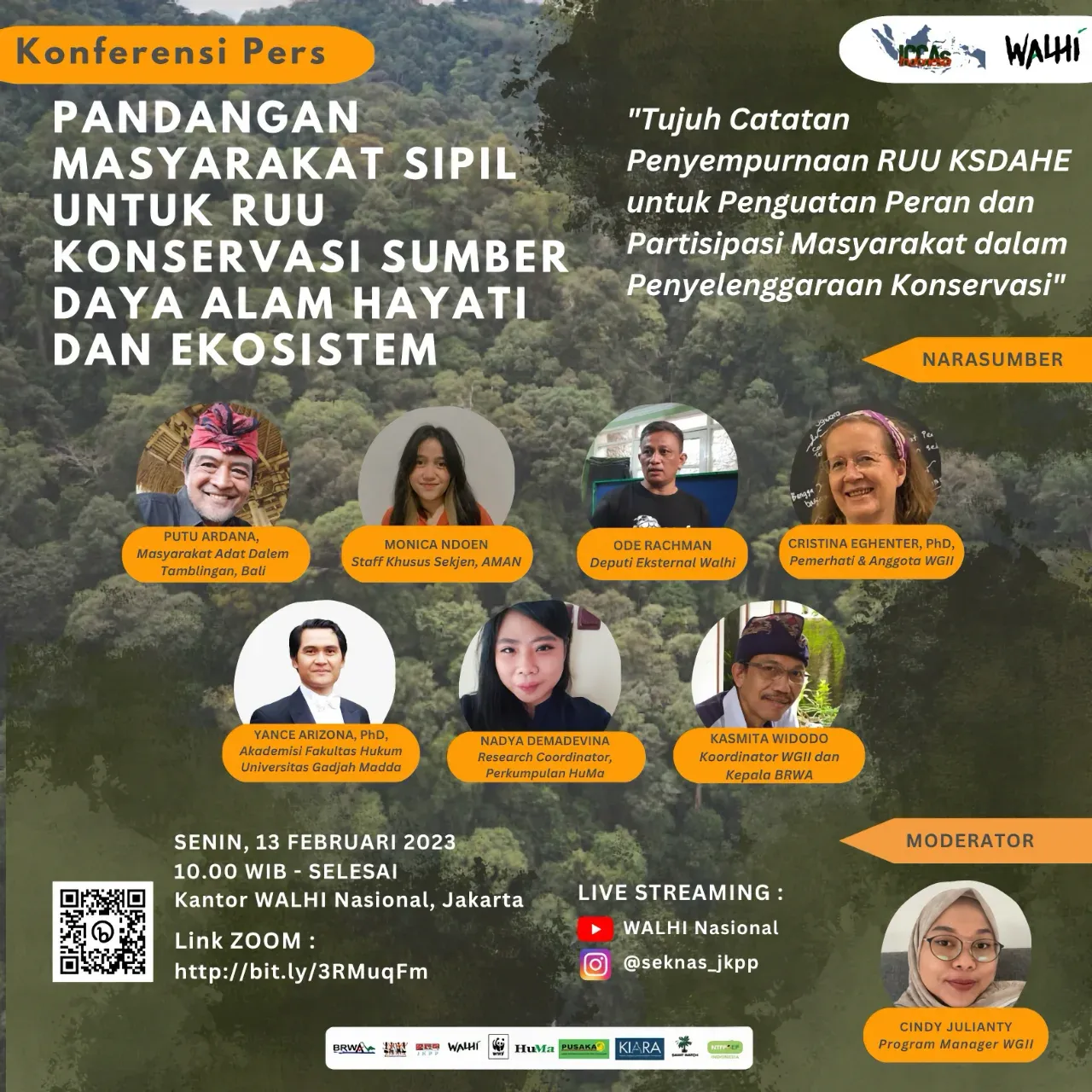
Working Group ICCAs Indonesia (WGII) Presents Views and Notes on the Improvement of the Draft Law on Conservation of Biological Natural Resources and Their Ecosystems (RUU KSDAHE)
Monday, February 13, 2023 - Working Group ICCAs Indonesia (WGII) together with Walhi held a Press Conference to present the views of the civil society coalition and indigenous peoples on the legislation of RUU KSDAHE. "The initiative for the legislative process of the Draft Law has been ongoing since 2016, but it was once removed from the national legislative program, and in 2022 it was reintroduced into the national legislative program. Currently, this Draft Law has entered the Stage I Discussion phase. A Working Committee for the Draft Law has been formed, and the government has also submitted a DIM which essentially still insists on the conservation management version of Law No.5 of 1990, which implies a more state-centered conservation paradigm," explained Kasmita Widodo, WGII Coordinator.
Important Notes on RUU KSDAHE
Yance Arizona, PhD stated, "There are positive changes in the substance of the RUU KSDAHE proposed by the Indonesian House of Representatives, but its substance cannot fully illustrate meaningful participation both in the drafting process and in conservation management, even though this Draft Law is very important to shift the old conservation model and promote more inclusive and human rights-based conservation."
Indigenous and local communities play a very important role in the management of conservation areas in Indonesia. According to data from the Indigenous Peoples Alliance of the Archipelago (AMAN), there are about 1.6 million hectares of customary land overlapping with conservation areas, and the Participatory Mapping Network (JKPP) reports show an overlap of participatory maps covering 4.5 million hectares in Conservation areas. According to HuMawin data, of the 86 forestry conflicts, 27 conflicts are in National Parks, where 13 of these cases involve criminalization and violence. "Indigenous peoples have experienced a long history of conflict with conservation areas and are vulnerable to criminalization in conservation management practices in Indonesia. The Draft Law can actually be a solution to unravel conflicts between indigenous peoples and conservation areas, but with the increasing conditional recognition for indigenous peoples, rather than simplifying it. This Draft Law could become a new stumbling block in the struggle for the recognition of indigenous peoples' rights in conservation areas," explained Monica Ndoen (Special Staff of AMAN Secretary-General).
This experience feels very real. Putu Ardana from the Dalem Tamblingan Indigenous Community shared his experience facing the complexity of obtaining recognition for the Alas Mertajati Customary Forest "We have been protecting the forest long before our area was designated as a Nature Tourism Park. The designation of our forest as a Nature Tourism Park is far from the conservation concept we believe in. Because all this time we have treated Alas Mertajati as a sacred area, not to mention the recognition through regional policies also hit a dead end. Our fundamental question is, has the state studied the conservation concept practiced by indigenous peoples and made it a reference? In my opinion, the indigenous peoples' conservation concept is far more holistic and sophisticated."
Nadya Demadevina, Research Coordinator of HuMa, expressed her suspicion that "The formal and material aspects of the RUU KSDAHE are still laden with the ego of certain scientific disciplines. This Draft Law clearly does not take an interdisciplinary law-making approach, so substantively it does not feel the need to address social issues and conflicts, for example."
"The 90s conservation regime must be abandoned because it no longer fits the current conditions. Indonesia's population has increased by almost 100 million since 1990, and it is important to adjust the conservation paradigm that respects and recognizes human rights and addresses today's climate crisis challenges. Indigenous and local communities cannot be separated from their sources of livelihood, and consciously, they have been practicing their version of 'conservation' and it must be recognized that they are the main actors of that conservation. Documentation of indigenous peoples' conservation practices has also been widely conducted. For example, by WGII, and now it has reached 460,000 hectares, with an indication of 4.5 million hectares," added Ode Rakhman (External Deputy of Walhi).
In the global context, the results of the 15th Conference of the Parties (COP) on the Convention of Biological Diversity (CBD) have begun to show new hope in strengthening inclusive and human rights-based conservation practices. The 15th CBD member meeting produced targets that are very good at accommodating the rights of indigenous peoples and local communities, including women and youth, in conservation management, including targets 1, 3, 9, 19, and 23. As a member country of the CBD, the Indonesian government needs to reflect the same intentions and commitments in the international agreement into national regulations, including the RUU KSDAHE.
Demands and Calls from the Civil Society Coalition
"The civil society coalition through WGII demands and invites the government and law drafters to improve the formal and material aspects of the RUU KSDAHE, which are comprehensively outlined in the Policy Brief Seven Notes on the Improvement of the RUU KSDAHE for Strengthening the Role and Participation of the Community in Conservation Management," Cindy Julianty, WGII program manager, concluded.
The Press Conference coverage can be accessed on: Walhi National YouTube Channel_Press Conference
The Policy Brief can be accessed on the website: Policy Brief Seven Notes on the Improvement of the RUU KSDAHE for Strengthening the Role and Participation of the Community in Conservation Management
Contact Person:
Lasti Fardila (0813-8860-1039)

Join Our Newsletter
Berlangganan buletin kami untuk mendapatkan pembaruan terbaru, berita, acara, dan aktivitas komunitas langsung ke kotak masuk Anda.
We respect you privacy, your email is safe with us.